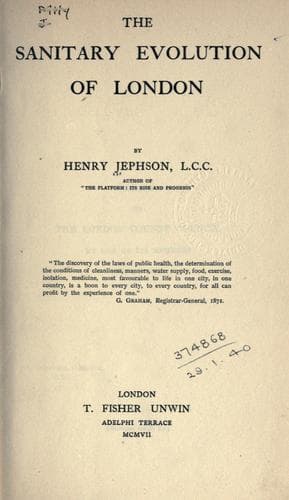
The Sanitary Evolution of LondonJephson, Henry (Henry Lorenzo)
History
The Sanitary Evolution of London
Jephson, Henry (Henry Lorenzo)
Public health -- England -- London
"The Factory and Workshop Act" of 1901 dealt with the latter. It
was the amendment and final codification of a mass of piecemeal
legislation which had been spread over a period of years.
In 1878, previous enactments on the subject had been consolidated
into one Act. That Act was amended in 1883, 1891, and 1895. All were
now finally embodied in this Act of 1901 with several additions
and amendments. Additional sanitary provisions were made as to the
ventilation of factories and workshops, and as to the drainage of
floors. Bakehouses came within the scope of the Act, and the law was
made much more stringent as to them. After January 1, 1904, it would
be unlawful to use any underground bakehouse unless certified by the
Borough Council to be suitable.
A register of workshops was to be kept, and the Medical Officer of
Health was, in his annual report, to report specifically on the
administration of the Act in workshops and workplaces--a direction
which ensured publicity as to the action of the local authorities.
The powers of the sanitary authorities were extended by the Act, and
certain duties necessary for efficient administration imposed upon them.
The Act also ensured the inspection of dwelling-houses where there were
outworkers.
The work imposed on the Sanitary Authorities was very considerable as a
very large number of premises came under their supervision, and every
workroom in each workshop had to be measured in order that its cubic
space might be ascertained; and when the subsequent routine inspection
of the premises, and of outworkers' premises, remedying of defects and
other duties, were taken into consideration, the magnitude of the work,
and the necessity of an adequate staff of officers, were evident.
The records show that at the end of 1904, 34,488 workshops in London
were under the supervision of the local authorities. The necessity of
inspection was demonstrated by the fact that 18,922 conditions required
remedying.
Improvement was testified to by the Medical Officers of Health,
overcrowding was diminished, and it was further stated that "employers
are found to co-operate willingly with the local authorities in the
remedy of faulty conditions."
Altogether, then, when a comparison is made between the conditions of
the factories and workshops, and workplaces in which the people worked
in the middle of the last century and now, the contrast is remarkable.
The worst of the evils have been swept away, and healthy conditions of
work have taken their place.
And the limitations put upon the labour of children and young persons
and women have all been to the good of those subjected to them. And the
public health of London, so far as this very large and very valuable
portion of the population is concerned, has been immensely the gainer.
The second of the three Acts since 1900, which had a vital bearing on
the sanitary condition of the people of London, was "The Metropolis
Water Act" of 1902.
Public-domain text, read in full here on John Shaqi.
Reviews
Reviews
No reviews yet
Be the first to share your thoughts on this work.
Elsewhere in the archive
Join the Discussion
Join the discussion
Sign in to leave a comment or review.
Sign InorCreate an account