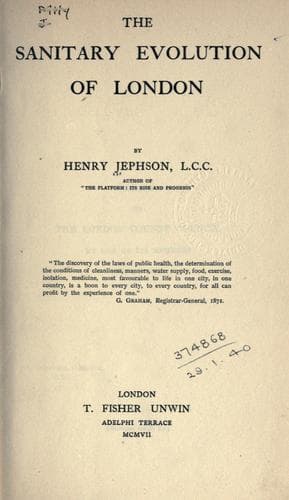
The Sanitary Evolution of LondonJephson, Henry (Henry Lorenzo)
History
The Sanitary Evolution of London
Jephson, Henry (Henry Lorenzo)
Public health -- England -- London
The supply of water in the eighteen-fifties had been very limited in
quantity, and, with the exception of that supplied by one company,
abominable in quality. And progress to a better state of things was
slow. Improvements were made most unwillingly and haltingly by the
Water Companies, and only under Parliament's reluctant compulsion,
whilst the inaction of most, and the obstruction of some, of the
Vestries and District Boards, and the hostility of "owners" of houses
to being put to expense for water fittings, still further impeded
reform, and perpetuated the evils inflicted upon the inhabitants of
London--suffering, disease, and death.
The "slaughter wells" and the sewer-ditches were, however, filled up
and those evil sources of supply ended. And a supply of water was
gradually extended to the streets which were without any, and an
increased supply to others which had but little; but it was not until
1899, the very end of the century, that the County of London was, for
the first time, receiving a constant supply in accordance with the
provisions of the Metropolis Water Act of 1871. And by slow degrees
the sources of defilement of the water were reduced, and a larger
proportion of the dirt ingredients filtered out, until at last some of
the worst evils connected with the supply were rectified. And in 1891
it was enacted by Parliament[191] that a dwelling-house without a
proper and sufficient supply should be a "nuisance" liable to be dealt
with summarily.
The main cause of all the grave disadvantages the people of London had
so unceasingly suffered under in this matter arose from the fact that
the interests of the Water Companies and the interests of the people of
London ran directly counter to each other. London, in fact, had from
the very outset been at the mercy of trading companies for its supply
of this necessity of life, and bitter cause, indeed, had London to rue
it.
It is too soon to know what improvements will result in the supply
of water to the people of London, but in the interests of the public
health it is most unsatisfactory that the public should even now be
debarred from that direct control which alone can secure them the
fullest benefits.
In another of the numerous branches of the great subject of the public
health of London--the widening of the streets and thoroughfares--the
improvements made in process of years was marked, and the better
provision of light and air and breathing space has been considerable.
The total gross cost of new streets and improvements carried out by
the Metropolitan Board of Works had amounted to over £12,000,000,[192]
whilst it had contributed another million and a half to the cost
of smaller street improvements carried out by the "City" and other
districts, which latter also expended considerable sums.
Public-domain text, read in full here on John Shaqi.
Reviews
Reviews
No reviews yet
Be the first to share your thoughts on this work.
Elsewhere in the archive
Join the Discussion
Join the discussion
Sign in to leave a comment or review.
Sign InorCreate an account