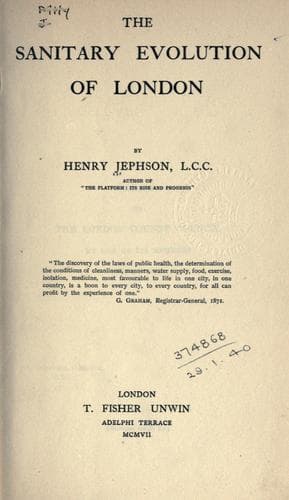
The Sanitary Evolution of LondonJephson, Henry (Henry Lorenzo)
History
The Sanitary Evolution of London
Jephson, Henry (Henry Lorenzo)
Public health -- England -- London
The London County Council continued the policy of the Metropolitan
Board of Works, and by the year 1904-5 it had carried out, or was in
process of carrying out, improvements at an estimated gross cost of
over £11,000,000,[193] the greatest and most costly of all being the
new thoroughfare--Kingsway and Aldwych--connecting Holborn with the
Strand, which swept away some of the most notorious and worst slums in
London.
In addition to these, many local improvements have been carried out by
the "City" and by the Vestries and District Boards, and later by the
Borough Councils. These were estimated to cost about £1,800,000. The
total work accomplished, therefore, has been very considerable, but the
cost has been huge; amounting in the whole to about £27,000,000.
Of greater value to the health of the people has been the increase of
the number of parks and open spaces in London, not merely in preventing
land being built over, but in the opportunities afforded the people,
and especially the younger portion of them, for exercise.
Here considerable acquisitions have been made since the time of the
Metropolitan Board of Works. Immediately after the creation of the
London County Council two generous gifts were made to the citizens of
London--Waterlow Park of 30 acres and Myatt's Fields--and the Council
had acquired Hackney Marsh, with 337 acres; Brockwell Park, with 127
acres; and Avery Hill, 84 acres; and some distance from London, 803
acres of Hainault Forest. In addition to these several small pieces of
ground were acquired and thrown open as public gardens and recreation
grounds.
The "City" had also acquired, outside the County of London, Epping
Forest, about 5,560 acres in extent, Burnham Beeches, 375 acres;
Coulsdon Common, 347 acres; and a few small open spaces in the "City"
itself.
And many acquisitions had been made by the Vestries and District
Boards, and, since their supersession, by the Borough Councils.
Purity of air was another of the important elements of a satisfactory
health condition.
Once that the Thames had ceased to be the main sewer of London, and
once that the hundreds of thousands of cesspools were filled in and
abolished, the most persistent and fruitful and worst of the causes
of the impurity and unwholesomeness of the atmosphere were removed.
Gradually too, but only too slowly--a slowness resulting in widespread
loss of health and life--were the noxious trades in London made
amenable to the law, and somewhat less noxious to those living in their
immediate neighbourhood; this, too, without that ruin to trade and
manufactures which was always predicted when any effort was made to
prevent the prevalence of intolerable nuisances.
Public-domain text, read in full here on John Shaqi.
Reviews
Reviews
No reviews yet
Be the first to share your thoughts on this work.
Elsewhere in the archive
Join the Discussion
Join the discussion
Sign in to leave a comment or review.
Sign InorCreate an account