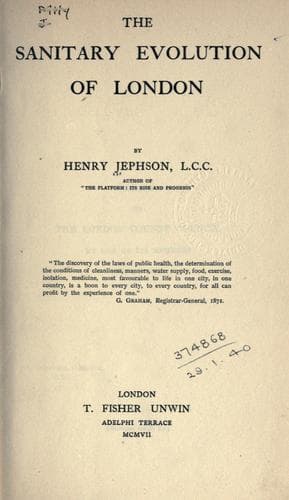
The Sanitary Evolution of LondonJephson, Henry (Henry Lorenzo)
History
The Sanitary Evolution of London
Jephson, Henry (Henry Lorenzo)
Public health -- England -- London
The duty of administering the provisions of the law relating to the
abatement of smoke nuisances rested with the police. Under their action
a steady reduction had taken place in offences against the law. In
1882, 1,248 cases were reported, and there had been 162 convictions;
and in 1890 the numbers had sunk to 702 reported cases and 46
convictions.
In 1891, by the Public Health London Act, the duty was transferred to
the Sanitary Authorities. Considerable use has been made by them of
the Act. In many cases severe penalties were imposed, and the general
result has been a very satisfactory improvement. Much, however, of the
fouling of the atmosphere is caused by factories outside London, and
consequently outside the control of the local authorities of London.
And yet another of the great branches of the general subject of the
public health is the food supply of the people. It would be difficult
to give any approximate estimate even of the part which good or bad
food has in its effect upon the public health, or to produce any
statistics on the subject, but, undoubtedly, it is a very large part;
and every now and then the outbreak of some serious illness and heavy
loss of life, directly traceable to the consumption of bad food, shows
how important it is to safeguard the people from such disasters.
Thus in 1901 there was an outbreak of scarlet fever, in which some 300
persons were attacked, directly traced to an infective milk supply.
Previous to the date of the Nuisances Removal Act of 1855 there was,
so far as London was concerned, practically no control or supervision
over the food sold to and consumed by the people. That Act contained
a section providing for the inspection of food by the local sanitary
authority, so the importance of securing wholesome food for the people
was then recognised. Little, if any, use was made of the power thus
given, and the Act was amended and extended; but even then it was
almost a dead letter.
As years advanced great scientific discoveries demonstrated the fact
that some of the most dangerous diseases, such as typhoid and scarlet
fever, could be conveyed in food of various sorts, and opened up a
new vista of dangers as to the conveyance of disease.[194] And the
huge size of London, and the vast numbers of its population, increased
enormously the difficulty of safeguarding the public from the dangers
of contaminated food.
The first and greater portion of this work was done by the Corporation
of the City of London. Its Committee, the Port Sanitary Authority,
was able to prevent large quantities of bad meat which arrived by sea
being put upon the markets; and the Corporation, which administered
the principal markets of London--the cattle-markets at Deptford
and Islington, the fish-market at Billingsgate, and the others at
Smithfield and Leadenhall and Spitalfields--by a system of inspection,
prevented large quantities of bad or diseased food being sold to the
public.
Public-domain text, read in full here on John Shaqi.
Reviews
Reviews
No reviews yet
Be the first to share your thoughts on this work.
Elsewhere in the archive
Join the Discussion
Join the discussion
Sign in to leave a comment or review.
Sign InorCreate an account