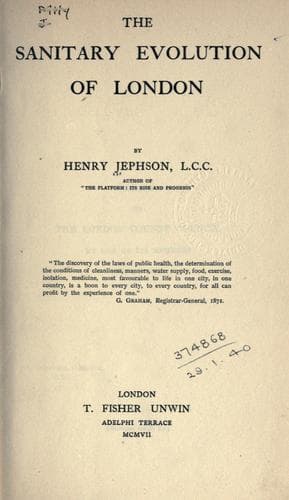
The Sanitary Evolution of LondonJephson, Henry (Henry Lorenzo)
History
The Sanitary Evolution of London
Jephson, Henry (Henry Lorenzo)
Public health -- England -- London
Ludicrous, truly, was the idea that the countless thousands of
nuisances existing in London could be remedied, or even temporarily
abated, by so cumbrous, dilatory, and complicated a procedure as the
complaint of an individual backed by the certificate (which would
have to be paid for) of two doctors to the officer of a more or
less hostile and self-interested local body, who might or might not
bring the complaint before the Justices, whose decision, even if it
were in favour of the complainant, could only effect a reform so far
as the precise nuisance complained of was concerned, and that only
temporarily, for were the nuisance renewed the whole procedure would
have to be gone through again.
Yet this was the "better provision" propounded and enacted by
Parliament in 1846 for the regeneration of the sanitary condition of
the great masses of the people of London. Nor was it even intended to
be permanently available, for the Act was only to be in force for two
years.
The dreadful nemesis for such dense inappreciation by Parliament of
its obligations to the community was, unfortunately, soon to fall
heavily upon the unhappy people of the metropolis. Thousands of
miles away in Hindoostan, Asiatic cholera of a deadly type had been
playing havoc with the people of the country. Thence it was slowly
but steadily moving westward; so much so that the desirability of
making some preparations for defence against its invasion of England
became apparent; and in 1847 a Royal Commission was appointed to
"inquire whether any, and what, special means might be requisite for
the improvement of the health of the metropolis, with regard more
especially to the better house, street, and land drainage, ... the
better supply of water for domestic use, &c., &c., &c."
One important conclusion was at once forced upon the Commissioners,
namely, that the great and vital task of making adequate provision for
the sewerage of London could not be accomplished so long as it was
entrusted to several bodies, each with a district of its own.
"Everything," they said, "pointed to the necessity of operations being
superintended by one competent body"; and they declared that it was
expedient that a Commission for the entire drainage of the whole of the
metropolis should be appointed with a special view to such measures,
and with aid to carry them out.
This report was followed in the ensuing year (1848) by an Act of
Parliament[30] abolishing the various Commissions of Sewers (except
those of the City), and creating in their stead one executive body
whose members were to be appointed by the Crown.
Wide powers were given to this central body: among them that no house
was to be built or re-built without proper drains, and without proper
sanitary conveniences, and that if houses built before the passing of
the Act were not properly drained, the Commissioners might order the
work to be done.
Public-domain text, read in full here on John Shaqi.
Reviews
Reviews
No reviews yet
Be the first to share your thoughts on this work.
Join the Discussion
Join the discussion
Sign in to leave a comment or review.
Sign InorCreate an account