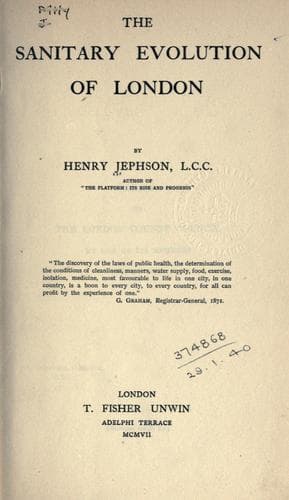
The Sanitary Evolution of LondonJephson, Henry (Henry Lorenzo)
History
The Sanitary Evolution of London
Jephson, Henry (Henry Lorenzo)
Public health -- England -- London
And Parliament, after an unusual amount of discussion, passed an
Act[27] for extending the practice of vaccination, and enacted that
Boards of Guardians might contract with their Medical Officers or other
medical practitioners "for the vaccination of all persons resident in
their Union or Parish."
And at the same time "inoculation" or "otherwise producing smallpox"
was made penal--to the extent of one month's imprisonment.
In 1846 there was a sudden display of Parliamentary energy in health
matters.
The total want of baths and wash-houses for the poorer classes of the
people in the towns was brought under the notice of the Legislature,
and, as it was deemed "desirable for the health, comfort, and welfare
of the inhabitants of towns, &c., to encourage the establishment
therein of baths, wash-houses, and open bathing places," an Act was
passed giving power to the Parochial Authorities to establish such
institutions and to borrow money for the purpose.[28]
Their provision would have tended to an increased degree of cleanliness
among the people, and consequently an improved sanitary condition, but
it was long before many of these institutions were established, the
local authorities being slow in availing themselves of the facilities
thus offered, and this piece of legislation--like every other of the
sort--being purely permissive or facilitatory.
And in the same year Parliament so far awakened to the fact that
certain causes of disease were removable, that in a preamble to an
Act[29] it acknowledged that it was "highly expedient for the purposes
of preserving the health of Her Majesty's subjects that better
provision should be made for the removal of certain nuisances likely to
promote or increase disease."
The better provision made by the Act did not amount to much. There
were two forms of insanitary evil to be combated: one the chronic
insanitary condition of the masses of the people, the other the
invasion of the country by some exceptional or unusual epidemic disease.
As to the former, authority was given to certain public officers,
on receipt of a certificate of two medical men, to complain of the
existence of certain nuisances. The Justices before whom the case was
heard might order the abatement of the nuisance; and if the order were
not obeyed, the parties complaining might enter upon the necessary
cleansing of such dwelling, and the cost of the same might be imposed
on the owner or occupier.
In London, the power of complaint was vested in the officers of those
petty local bodies which have already been described, and, in their
default, in the Boards of Guardians.
Public-domain text, read in full here on John Shaqi.
Reviews
Reviews
No reviews yet
Be the first to share your thoughts on this work.
Join the Discussion
Join the discussion
Sign in to leave a comment or review.
Sign InorCreate an account