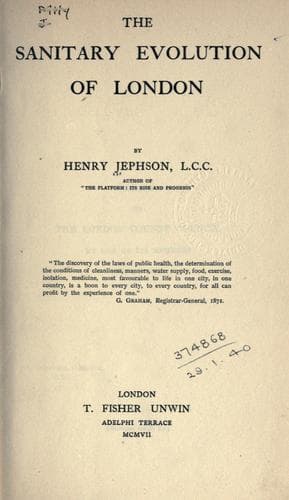
The Sanitary Evolution of LondonJephson, Henry (Henry Lorenzo)
History
The Sanitary Evolution of London
Jephson, Henry (Henry Lorenzo)
Public health -- England -- London
The explanation of the inaction and hostility of the local authorities
lay in the fact that the various measures prescribed by the Act
interfered with private interests, and especially with interests which
were largely represented on the Boards of Guardians. Among the members
of those boards there was often "an antagonistic power" at work which
prevented proper attention being paid to the sanitary condition of the
localities of the poor. In many instances, owners of small houses and
cottage property, to which class of dwellings the provisions of the
Act more particularly applied, were themselves members of such boards,
and when this was not the case, they exerted an influence not the less
powerful because it was indirect. This interest often conspired to
impede efficient sanitary measures.[38]
Local interests also operated, the apprehension being that if
active and really efficient measures were adopted the trade of the
neighbourhood would suffer.
In one instance--an instructive one--where the epidemic had
extensively prevailed among the poor, its existence was denied, and
house-visitation resisted, till, after considerable delay and loss of
life, a number of shopkeepers were attacked by the disease, and _then_,
all opposition ceased.
The evidence of the unfitness of the local authorities charged with
the administration of the Act for the duties imposed upon them was
overwhelming. The unfortunate position was accentuated and intensified
by the fact that the General Board of Health had no power either of
compelling the local authorities to do their duty or of itself acting
in default of their neglect; and the absence of this first essential of
effective administration hampered and crippled its action.
The Board summed up its experience of this great visitation of
1848-9:--
"The evidence shows that where combined sanitary arrangements have been
carried into effect the outbreak of the pestilence has been sometimes
averted; that where not prevented, its course has been gradually
arrested.
"That where material improvements have been made in the condition
of the dwellings of the labouring classes, there has been an entire
exemption from the disease, and where minor improvements were made, the
attacks have been less severe and less extensive.
"That with reference to the measure of prevention, the immunity from
the disease has been in proportion to the extent to which those
measures have been carried into effect systematically and promptly."
By the end of the year the epidemic was practically over. And then the
usual thing took place.
It is described a few months later by Dr. Grainger, who wrote:--
Public-domain text, read in full here on John Shaqi.
Reviews
Reviews
No reviews yet
Be the first to share your thoughts on this work.
Join the Discussion
Join the discussion
Sign in to leave a comment or review.
Sign InorCreate an account