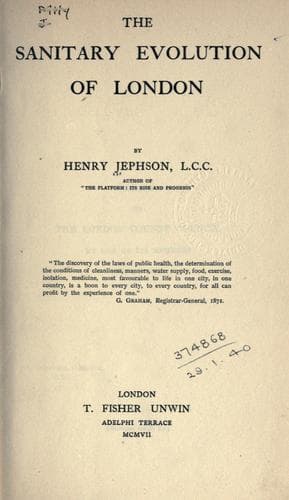
The Sanitary Evolution of LondonJephson, Henry (Henry Lorenzo)
History
The Sanitary Evolution of London
Jephson, Henry (Henry Lorenzo)
Public health -- England -- London
"In many of the most densely populated districts the inspectors of
nuisances have been dismissed, the cleansing operations have been
relaxed, and there is too much reason to apprehend that the courts and
alleys will lapse back again into their accustomed filth, ... that
houses proved by the evidence of medical officers, inspectors, and
local authorities to be unfit for human habitation will long continue
to remain 'pest-houses,' spreading disease around; and that, in the
midst of these tolerated and accumulated evils, the industrious classes
will continue as heretofore to be decimated by fever, or, should it
again break out, by cholera."[39]
CHAPTER I, PART III
The "City" of London, though constituting territorially and by
population but a small portion of the metropolis, affords much matter
of deep interest in connection with the sanitary evolution of London,
totally apart from those great economic forces emanating from it which
have dominated the whole of London life.
The "City" differed mainly, as has already been pointed out, from
"greater London" in that it had a real and active governing body for
its local affairs, and that that body was possessed of considerable
powers for dealing with the sanitary condition and requirements of
its inhabitants. That those sanitary powers were annually delegated
to a body entitled the Commissioners of Sewers in no way diminished
its sanitary authority or weakened its efficiency, for that body was
practically a Committee of its own, and had authority, directly or
indirectly, over nearly every one of the physical conditions which were
likely to affect the health or comfort of its inhabitants.
The "City" differed also in that it was able to obtain from the
Government and Parliament powers which neither Government nor
Parliament would grant to "greater London."
It differed too in that from 1848 onwards it was in beneficial
enjoyment of the services of a Medical Officer of Health.
But in many respects the "City" was a microcosm of the metropolis; and
though possessed of a local government, yet was it cursed with evils
which were the terrible legacy left it by the ignorance, indifference,
neglect, incapacity, or cupidity, of previous generations.
The graphic reports of its Medical Officer of Health--Dr. John
Simon--have left us a most vivid and valuable contemporary picture of
the sanitary condition and surroundings of the people living in the
favoured area about the middle of the last century, and they disclose,
in no hesitating manner, the desperate evils prevalent therein.
The Thames, "with the immeasurable filth" which polluted it, and its
acres of mud banks saturated with the reeking sewage of an immense
population, vitiated the atmosphere of the City, just as it did that of
other parts of London. But sewers there were in the City, of one sort
or another, over forty miles of them, and some of the filth of the City
was carried away, at least into the river.
Public-domain text, read in full here on John Shaqi.
Reviews
Reviews
No reviews yet
Be the first to share your thoughts on this work.
Join the Discussion
Join the discussion
Sign in to leave a comment or review.
Sign InorCreate an account