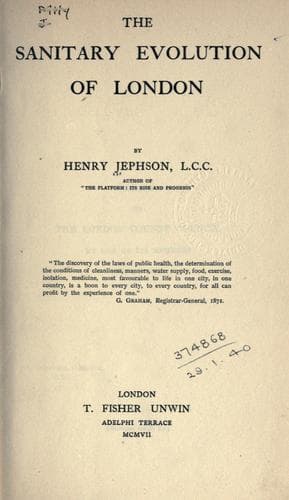
The Sanitary Evolution of LondonJephson, Henry (Henry Lorenzo)
History
The Sanitary Evolution of London
Jephson, Henry (Henry Lorenzo)
Public health -- England -- London
Foremost among the diseases which worked unceasing and deadly havoc
among the people was fever. By its wide and constant prevalence and
great fatality, it was the first upon which attention became fixed.
The returns which were collected as regarded it related to twenty
metropolitan unions or parishes, and in them only to the pauper
population, some 77,000 in number. But they showed that in the single
year of 1838, out of those 77,000 persons, 14,000, or very nearly
one-fifth, had been attacked by fever, and nearly 1,300 had died.[1]
Being limited to the technically pauper population this information
related only to one section of the community; but it nevertheless
afforded the means of forming a rough estimate of the amount of fever
among the community as a whole.
And another fact also at once became apparent, namely, that certain
parts of London were more specially and persistently haunted or
infested by fever than others. In Whitechapel, Holborn, Lambeth, and
numerous other parishes or districts, fever of the very worst forms
was always prevalent--"typhus, and the fevers which proceed from the
malaria of filth." The sanitary condition of those districts was
fearful, every sanitary abomination being rampant therein, whilst
certain localities in them were so bad that "it would be utterly
impossible for any description to convey to the mind an adequate
conception of their state." And most marvellous and deplorable of all
was the fact that this fearful condition of things was allowed, not
merely to continue, but to flourish without any attempt being made to
remedy, or even to mitigate, some of the inevitable and most disastrous
consequences.
As regarded the districts in which the wealthier classes resided,
systematic efforts had been made on a considerable scale to widen the
streets, to remove obstructions to the circulation of free currents of
air, and to improve the drainage--an acknowledgment and appreciation of
the fact that these things did deleteriously affect people's health.
But nothing whatever had been attempted to improve the condition of
the districts inhabited by the poor. Those districts were not given a
thought to, though in them annually thousands and tens of thousands of
victims suffered or died from diseases which were preventable.
Reports such as these attracted some degree of attention, and awakened
a demand for further information, and in 1840 the House of Commons
appointed a Select Committee to inquire as to the health, not only of
London, but of the large towns throughout the country. Their report[2]
enlarged upon the evils previously in part portrayed, and emphasised
them.
Public-domain text, read in full here on John Shaqi.
Reviews
Reviews
No reviews yet
Be the first to share your thoughts on this work.
Join the Discussion
Join the discussion
Sign in to leave a comment or review.
Sign InorCreate an account