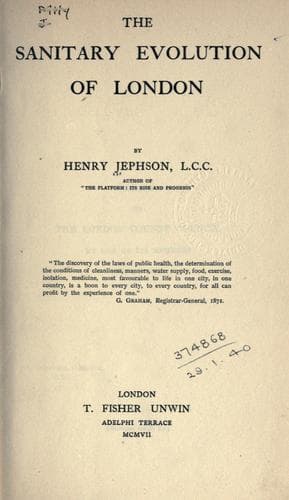
The Sanitary Evolution of LondonJephson, Henry (Henry Lorenzo)
History
The Sanitary Evolution of London
Jephson, Henry (Henry Lorenzo)
Public health -- England -- London
"Your Committee," they wrote, "would pause, from the sad statements
they have been obliged to make, to observe that it is painful to
contemplate in the midst of what appears an opulent, spirited,
and flourishing community, such a vast multitude of our poorer
fellow-subjects, the instruments by whose hands these riches were
created, condemned for no fault of their own to the evils so
justly complained of, and placed in situations where it is almost
impracticable for them to preserve health or decency of deportment,
or to keep themselves and their children from moral and physical
contamination. To require them to be clean, sober, cheerful, contented
under such circumstances would be a vain and unreasonable expectation.
There is no building Act to enforce the dwellings of these workmen
being properly constructed; no drainage Act to enforce their being
properly drained; no general or local regulation to enforce the
commonest provisions for cleanliness and comfort."
Lurid as were the details thus made public of the condition in which
the vast masses of the people in London were living, neither Parliament
nor the Government took any action beyond ordering successive inquiries
by Poor Law Commissioners, or Committees of the House of Commons, or
Royal Commissions.
Before one of these Commissions[3] the following striking evidence was
given--evidence which it might reasonably be expected would have moved
any Government to immediate action:--
"Every day's experience convinces me," deposed the witness,[4] "that a
very large proportion of these evils is capable of being removed; that
if proper attention were paid to sanitary measures, the mortality of
these districts would be most materially diminished, perhaps in some
places one-third, and in others even a half.
* * * * *
"The poorer classes in these neglected localities and dwellings are
exposed to causes of disease and death which are peculiar to them; the
operation of these peculiar causes is steady, unceasing, sure; and the
result is the same as if twenty or thirty thousand of these people were
annually taken out of their wretched dwellings and put to death--the
actual fact being that they are allowed to remain in them and die. I am
now speaking of what silently but surely takes place every year in the
metropolis alone."
But the Government took no action--beyond a Building Act which did
little as regarded the housing of the people. No local bodies took
action, and years were to pass before either Government or Parliament
stirred in the matter.
In dealing historically with matters relating to London as a whole, it
is to be remembered that for a long time there had been practically
two Londons--that defined and described as the "City," and the rest of
London--that which had no recognised boundaries, no vestige of
corporate existence, and which can best be described by the word
"metropolis."
Public-domain text, read in full here on John Shaqi.
Reviews
Reviews
No reviews yet
Be the first to share your thoughts on this work.
Join the Discussion
Join the discussion
Sign in to leave a comment or review.
Sign InorCreate an account