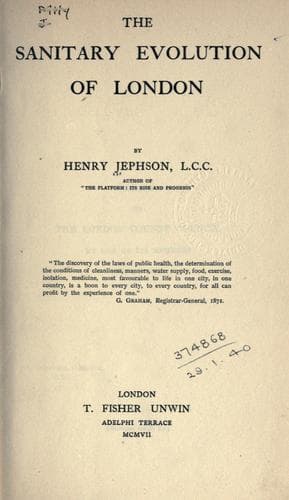
The Sanitary Evolution of LondonJephson, Henry (Henry Lorenzo)
History
The Sanitary Evolution of London
Jephson, Henry (Henry Lorenzo)
Public health -- England -- London
And there were very many noxious and offensive trades in close
dependence upon "the original nuisance" of the slaughter-house, and
round about it, "the concomitant and still more grievous nuisances
of gut-spinning, tripe-dressing, bone-boiling, tallow-melting,
paunch-cooking, &c., &c."
Certain it is that offensive businesses of these and other sorts were
carried on by their owners with an absolute disregard to the comfort or
health of the public.
The matter was a difficult one to deal with, as any severe restrictions
might destroy the trade or manufacture and take away from the people
the employment which gave them the means of earning a livelihood.
Furthermore, such restrictions were usually resented as an infraction
of personal liberty. Dr. Simon forcibly and conclusively answered this
contention.
"It might," he wrote, "be an infraction of personal liberty to
interfere with a proprietor's right to make offensive smells within
the limits of his own tenement, and for his own separate inhalation,
but surely it is a still greater infraction of personal liberty
when the proprietor, entitled as he is to but the joint use of an
atmosphere which is the common property of his neighbourhood, assumes
what is equivalent to a sole possession of it, and claims the right of
diffusing through it some nauseous effluvium which others, equally with
himself, are thus obliged to inhale."
Some improvement in this respect was rendered possible by the Act of
1851, which enacted that whatever trade or business might occasion
noxious or offensive effluvia, or otherwise annoy the inhabitants of
its neighbourhood, "shall" be required to employ the best known means
for preventing or counteracting such annoyance.
But the remedy scarcely appears to have been availed of or enforced,
and "greater London" was, as usual, excluded from the Act.
Another more constant pollution of the air was that resulting from
intramural burial. "Overcrowding" in the "City" was not limited to the
living; it extended even to the dead, and though the dead themselves
had passed beyond any further possible harm from it, yet their
overcrowding affected disastrously those they had left behind. Here
the evils already described as existing in "greater London" existed
also in acute form. Two thousand bodies or more were interred each year
actually within the "City" area, and the burial grounds were densely
packed. And "in all the larger parochial burying grounds, and in most
others, the soil was saturated with animal matter undergoing slow
decomposition."
And the vaults beneath the churches were "in many instances similarly
overloaded with materials of putrefaction, and the atmosphere which
should have been kept pure and without admixture for the living, was
hourly tainted with the foetid emanations of the dead...."
In Dr. Simon's words:--
Public-domain text, read in full here on John Shaqi.
Reviews
Reviews
No reviews yet
Be the first to share your thoughts on this work.
Join the Discussion
Join the discussion
Sign in to leave a comment or review.
Sign InorCreate an account