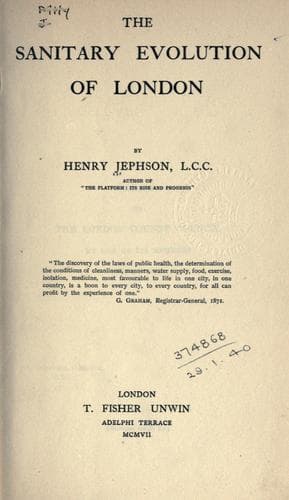
The Sanitary Evolution of LondonJephson, Henry (Henry Lorenzo)
History
The Sanitary Evolution of London
Jephson, Henry (Henry Lorenzo)
Public health -- England -- London
"In inspecting the courts and alleys of the 'City,'" he wrote, "one
constantly sees butts, for the reception of water, either public
or in the open yards of houses, or sometimes in their cellars; and
these butts, dirty, mouldering, and coverless; receiving soot and all
other impurities from the air; absorbing stench from the adjacent
cesspool; inviting filth from insects, vermin, sparrows, cats, and
children; their contents often augmented through a rain-water pipe by
the washings of the roof, and every hour becoming fustier and more
offensive. Nothing can be less like what water should be than the fluid
obtained under such circumstances."
It is interesting to observe that the evils of the system of water
supply by private companies were, even in the "City," so manifest that
Dr. Simon expressed his opinion that the only satisfactory solution
of the difficulty in connection therewith was the acquisition by
the public authority of the control of the supply, and he urged the
adoption of the principle of what is now denounced by some people as
"municipal trading."
In every practical sense the sale of water in London was a monopoly.
"The individual customer," wrote Dr. Simon, "who is dissatisfied with
his bargain can go to no other market; and however legitimate may be
his claim to be supplied with this prime necessary of life at its
cheapest rate, in the most efficient manner, and of the best possible
quality, your Honourable Court (the Commissioners of Sewers) hitherto
possesses no power to enforce it."
In the Public Health Act of 1848 the principle had been recognised by
Parliament so far as towns in the country were concerned--local Boards
of Health being authorised to provide their district with such a supply
of water as might be proper or sufficient, or to contract for such a
supply. He urged that the City should obtain a similar power.
"All the advantages which could possibly be gained by competition,
together with many benefits which no competition could ensure, would
thus be realised to the population under your charge."
But that solution of the difficulty was more than half a century in
advance of its accomplishment so far as either the "City" or "greater
London" was concerned.
As to the atmosphere in the "City," there seems to have been no limit
to the pollutions thereof, all of which were injurious to the health of
the public.
Numerous noxious and offensive trades were carried on in the most
crowded places.
Directly and indirectly, slaughtering of animals in the "City" was
prejudicial to the health of the population, and exercised a most
injurious influence upon the district.
The number of slaughter-houses registered and tolerated in the "City"
in 1848 amounted to 138, and of these, in 58 cases, the slaughtering
was carried out in the vaults and cellars.[40]
Public-domain text, read in full here on John Shaqi.
Reviews
Reviews
No reviews yet
Be the first to share your thoughts on this work.
Join the Discussion
Join the discussion
Sign in to leave a comment or review.
Sign InorCreate an account