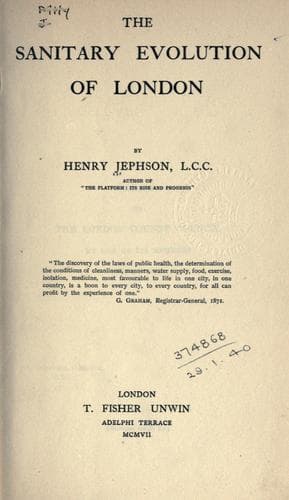
The Sanitary Evolution of LondonJephson, Henry (Henry Lorenzo)
History
The Sanitary Evolution of London
Jephson, Henry (Henry Lorenzo)
Public health -- England -- London
"And how much more justly may the neighbour appeal to you against each
such nuisance as an interference with his privacy; against the smoke,
the stink, the fever that bursts through each inlet of his dwelling,
intrudes on him at every hour, disturbs the enjoyment and shortens the
duration of his life. And for the rights of property--they are not
only pecuniary. Life, too, is a great property, and your Act (of 1851)
asserts its rights."
"The landlord of some overthronged lodging-house complains that to
reduce the number of his tenantry, to lay on water, to erect privies,
or to execute some other indispensable sanitary work, would diminish
his rental--in the spirit of your Act it is held a sufficient reply
that human life is at stake--and that a landlord in his dealings with
the ignorant and indefensive poor cannot be suffered to estimate
them at the value of cattle, to associate them in worse than bestial
habits, or let to them for hire at however moderate a rent the certain
occasions of suffering and death."
"Seeing the punctuality with which weekly visitation is made for
the collection of rents in these wretched dwellings it would not be
unreasonable to insist on some regulations for the clean and wholesome
condition of his premises, water supply, and scavenging, &c."
Such a regulation would "render it indispensable to the landlord
of such holdings to promote cleanly and decent habits among his
tenants--even to obtain security for their good behaviour."
The picture thus presented of the sanitary condition of the people
residing in the "City" about the middle of the last century is--it
must be acknowledged--a terrible one; but it rests upon unimpeachable
testimony.
The very grave and serious conclusion, however, follows from it--that
if the evils were thus terrible in the "City," with a comparatively
small population, only a little more than a twentieth of that of the
metropolis, and where there was a local government with wide powers for
dealing with matters affecting the public health--how infinitely more
serious was the condition of things in the "greater London" with its
huge population, and where there was practically no local government,
and no punitive law for insanitary misdoings and crimes.
In some degree, the evils the people suffered under were of their
own making, though many excuses can be urged in extenuation. In
some degree, too, the people were unquestionably the victims of
circumstances. But in the main, they were the victims of other people's
iniquities. It was those circumstances which the Government should have
altered, or, at any rate, have endeavoured to control or modify--it was
the unlimited power to do evil that the Government should have checked
and curbed; but "greater London" was virtually left outside the pale of
remedial legislative treatment by Parliament.
CHAPTER I, PART IV
Public-domain text, read in full here on John Shaqi.
Reviews
Reviews
No reviews yet
Be the first to share your thoughts on this work.
Join the Discussion
Join the discussion
Sign in to leave a comment or review.
Sign InorCreate an account