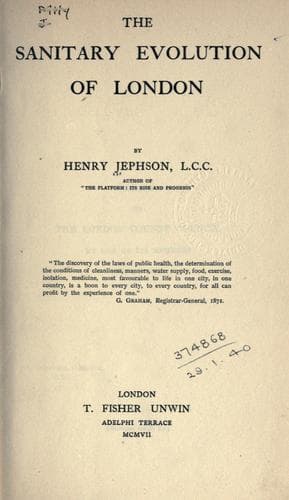
The Sanitary Evolution of LondonJephson, Henry (Henry Lorenzo)
History
The Sanitary Evolution of London
Jephson, Henry (Henry Lorenzo)
Public health -- England -- London
The great cholera epidemic of 1848-9 had deeply stirred public
feeling in London. It had destroyed 14,600 people (and diarrhoea,
its satellite, had destroyed many thousands more), and it had been
"accompanied by an amount of sickness and physical misery beyond
computation." But even all its horrors, and all the proofs it
afforded of the desperately insanitary condition of the masses in the
metropolis, were not sufficient to induce the Government to depart from
its policy of neglect, or to wring from Parliament measures which would
lay the basis for the alleviation of the sufferings of the working
population of the metropolis, or which would remove even a small part
of the evils which fell so heavily upon those least able to sustain
them, and least able to remove them.
The health of London was becoming worse every year. The number of
persons dying from preventable disease had been steadily increasing.
One gleam of hope there was, however. An increasing number of persons
were becoming interested in the health of the people, and were
awakening to the gravity of the subject, and to the public discredit
and inhuman scandal of the existing condition of things--an awakening
of interest which, in February, 1850, reached to the extent of a public
meeting.
The Bishop of London presided, and the meeting was rendered the more
remarkable by speeches from Lord Ashley, then actively pressing
sanitary and social questions forward, and by Charles Dickens.
Lord Ashley said:--
"The condition of the metropolis, in a sanitary point of view, was
not only perilous to those who resided in it, but it was an absolute
disgrace to the century in which they lived. It was a disgrace to
their high-sounding professions of civilisation and morality. They
were surrounded by every noxious influence--they were exposed to every
deadly pestilence.... The water they drank, the air they breathed, the
surface they walked on, and the ground beneath the surface, all were
tainted and rife with the seeds of disease and death....
"Let them look at another abomination--the existence of putrefying
corpses in graveyards and in vaults amidst the habitations of the
living--an abomination discountenanced by all the civilisation of
modern days, as it was by that of the ancient days--the practice of
intramural interments.
"Could anything be worse than the graveyards of the metropolis? Under
a surface of ground not amounting to 250 acres there had been interred
within thirty years in the metropolis far more than 1,500,000 human
beings. What must be the condition of the atmosphere affected by the
exhalations from that surface?...
"And what were the financial and social consequences of allowing such a
state of things to exist?
"At least one-third of the pauperism of the country arose from the
defective sanitary condition of large multitudes of the people...."
Charles Dickens said:--
Public-domain text, read in full here on John Shaqi.
Reviews
Reviews
No reviews yet
Be the first to share your thoughts on this work.
Join the Discussion
Join the discussion
Sign in to leave a comment or review.
Sign InorCreate an account