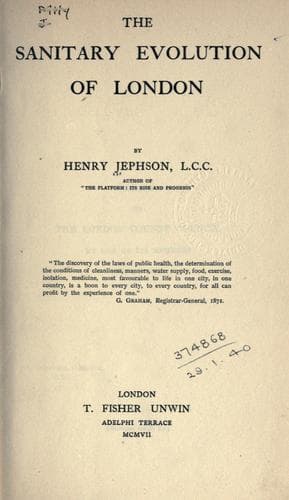
The Sanitary Evolution of LondonJephson, Henry (Henry Lorenzo)
History
The Sanitary Evolution of London
Jephson, Henry (Henry Lorenzo)
Public health -- England -- London
An "association of individuals" had already been formed--"The Society
for Improving the Condition of the Labouring Classes"--and work of
this class had to the extent of over £20,000 been carried out by it.
The new piles of buildings erected were eagerly availed of by people
of the working classes, and in a sanitary point of view they at once
demonstrated their very satisfactory immunity from disease.
The Act, however, being a voluntary or adoptive Act, was not likely
to be adopted and put into force by those by whom a certain amount of
financial liability might be incurred as the result. As a matter of
fact it never was put in force by any vestry, and it remained a dead
letter.
It was memorable, however, as embodying for the first time in
legislation the idea that the housing of the people was a public matter
with which a public authority might properly concern itself, even to
the extent of competing with private enterprise, and pledging the rates
as security.
The supply of water to London, both as regarded quality and quantity,
had, since the epidemic of 1848-9, been engaging the attention of
Committees of Parliament, the belief that the epidemic of cholera had
been increased and propagated by the filthy and impure water having
given an impetus to the demand for ameliorative measures. In 1852 an
Act[49] was passed by which the companies taking their water from
the Thames were required to remove their intakes to some place above
Teddington Lock, where the tide would not affect it, and the sewage of
London would not be intermixed with it. This was a considerable step
in the right direction, for though the river above Teddington Lock
received the sewage of many large towns and villages, it was at least
free from contamination by the sewage and filth of the metropolis.
Other improvements were also enacted. Reservoirs within a certain
distance of St. Paul's Cathedral were to be covered in, and all water
intended for domestic use was to be filtered before being supplied to
the consumer; and provision was also made for a constant supply of
water by every company within five years after the passing of the Act.
But the companies were given five years within which to effect the
removal of the intake from the foulest parts of the river to above
tidal reach--and thus for a wholly unnecessary term the cause which
had wrought such havoc among the people was permitted to continue its
disastrous effects.
CHAPTER I, PART V
The epidemic of cholera in 1849 had failed to produce any lasting
effect upon the local authorities or the public opinion of London, and
the nemesis of renewed neglect and indifference was once again to fall
upon the metropolis.
Cholera had kept hovering about. In 1852 a number of suspicious cases
occurred in various districts. In 1853 suspicion passed into certainty,
and the disease assumed the form of an epidemic--as many as 102 deaths
from it occurring in the first week in November. Then it died down.
Public-domain text, read in full here on John Shaqi.
Reviews
Reviews
No reviews yet
Be the first to share your thoughts on this work.
Join the Discussion
Join the discussion
Sign in to leave a comment or review.
Sign InorCreate an account