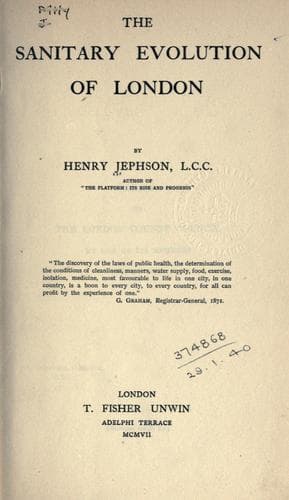
The Sanitary Evolution of LondonJephson, Henry (Henry Lorenzo)
History
The Sanitary Evolution of London
Jephson, Henry (Henry Lorenzo)
Public health -- England -- London
"Those who follow unwholesome trades led on by the thirst of gain,"
reported one Medical Officer of Health, "have no right to poison a
neighbourhood and swell its mortality."
The Medical Officer of Health for the Strand wrote (1856):--
"... The protection of the public health which has been committed to
your charge is, beyond doubt, of infinitely more importance than, and
should far outweigh the interests of, private individuals how numerous
soever they should be."
The Nuisances Removal Act, 1855, had given the local authority power on
the certificate of the Medical Officer of Health to take proceedings
against an offender, and had provided the means for inflicting a
penalty. And in some instances it was used, for the Medical Officer of
Health for Hackney reported:--
"Several proprietors of noxious trades having omitted to adopt the best
practicable means for preventing injury to health, in some cases legal
proceedings were taken against them."
The Medical Officer of Health for Whitechapel declared there was no
desire on his part to use the powers of the Act to the oppression
of any individual or to insist upon the adoption of such arbitrary
and stringent measures as shall drive wealthy manufacturers from the
district. "All that is necessary to be insisted upon is that the
business be so conducted that the health and comfort of the inhabitants
shall not be injured."
But whether it was from the unwillingness of the local authorities to
prosecute, or the difficulties of enforcing the law, the nuisances
continued to the great detriment of the health of the people.
And over and above this combination of nuisances, there was the
abominable smell from the river. That still was an evil.
"Rotherhithe," wrote the Medical Officer of Health, in July, 1858, "in
common with all other metropolitan riverside parishes, has suffered
considerable inconvenience during the last month from the stenches
arising from the filthy state of the Thames water. Perhaps in the
annals of mankind such a thing was never before known, as that the
whole stream of a large river for a distance of seven or eight miles
should be in a state of putrid fermentation. The cause is the hot
weather acting upon the ninety millions of gallons of sewage which
discharge themselves daily into the Thames. And by sewage must be
understood not merely house and land drainage, but also drainage
from bone-boilers, soap-boilers, chemical works, breweries, and gas
factories--the last the most filthy of all.... It is quite impossible
to calculate the consequences of such a moving mass of decomposition as
the river at present offers to our senses."
As one sums up all these disastrous influences, or rather, these
evil powers, unceasing in their work, by night and by day--in the
overcrowded dwelling and the street--with their victims unable to
escape, one realises somewhat the conditions under which great masses
of the people of London were living.
Public-domain text, read in full here on John Shaqi.
Reviews
Reviews
No reviews yet
Be the first to share your thoughts on this work.
Elsewhere in the archive
Join the Discussion
Join the discussion
Sign in to leave a comment or review.
Sign InorCreate an account