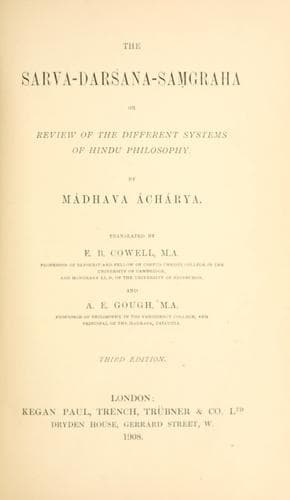
The Sarva-Darsana-Samgraha: Or, Review of the Different Systems of Hindu PhilosophyMadhava
ReligionEastern
The Sarva-Darsana-Samgraha: Or, Review of the Different Systems of Hindu Philosophy
Madhava
Philosophy, Hindu; Philosophy, Indic
The word _mankind_ imports that there is no restriction of the
doctrine to previously qualified students. Whoever he may be to whom
this exposition of the divine nature is made, he reaps its highest
reward, the emanatory _principium_ itself operating to the highest end
of the transmigrating souls. It has been accordingly laid down in the
Śiva-dṛishṭi by that supreme guide the revered Sománandanátha--
"When once the nature of Śiva that resides in all things
has been known with tenacious recognition, whether by proof
or by instruction in the words of a spiritual director,
"There is no further need of doing aught, or of any further
reflection. When he knows Suvarṇa (or Śiva) a man may cease
to act and to reflect."
The word _also_ excludes the supposition that there is room in self
which has recognised the nature of Maheśvara, and which manifests to
itself its own identity with him, and is therefore fully satisfied,
for any other motive than felicity for others. The well-being of
others is a motive, whatever may be said, for the definition of a
motive applies to it: for there is no such divine curse laid upon man
that self-regard should be his sole motive to the exclusion of a
regard for others. Thus Akshapáda (i. 24) defines a motive: A motive
is that object towards which a man energises.
The preposition _upa_ in _upapádayami_ (I set forth) indicates
proximity: the result is the bringing of mankind near unto God.
Hence the word _all_ in the phrase _the method of attaining all
felicities_. For when the nature of the Supreme Being is attained, all
felicities, which are but the efflux thereof, are overtaken, as if a
man acquired the mountain Rohaṇa (Adam's Peak), he would acquire all
the treasures it contains. If a man acquire the divine nature, what
else is there that he can ask for? Accordingly Utpaláchárya says--
"What more can they ask who are rich in the wealth of
devotion? What else can they ask who are poor in this?"
We have thus explained the motive expressed in the words _the method
of attaining all felicities_, on the supposition that the compound
term is a Tatpurusha genitively constructed. Let it be taken as a
Bahuvríhi or relative compound. Then the recognition of Maheśvara, the
knowing him through vicarious idols, has for its motive the full
attainment, the manifestation, of all felicities, of every external
and internal permanent happiness in their proper nature. In the
language of everyday life, recognition is a cognition relative to an
object represented in memory: for example, This (perceived) is the
same (as the remembered) Chaitra. In the recognition propounded in
this system,--there being a God whose omnipotence is learnt from the
accredited legendaries, from accepted revelation, and from
argumentation,--there arises in relation to my presented personal self
the cognition that I am that very God,--in virtue of my recollection
of the powers of that God.
Public-domain text, read in full here on John Shaqi.
Reviews
Reviews
No reviews yet
Be the first to share your thoughts on this work.
Elsewhere in the archive
Join the Discussion
Join the discussion
Sign in to leave a comment or review.
Sign InorCreate an account