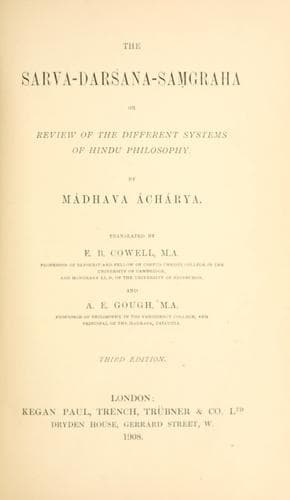
The Sarva-Darsana-Samgraha: Or, Review of the Different Systems of Hindu PhilosophyMadhava
ReligionEastern
The Sarva-Darsana-Samgraha: Or, Review of the Different Systems of Hindu Philosophy
Madhava
Philosophy, Hindu; Philosophy, Indic
Other Máheśvaras are dissatisfied with the views set out in the Śaiva
system as erroneous in attributing to motiveless and insentient things
causality (in regard to the bondage and liberation of transmigrating
spirits). They therefore seek another system, and proclaim that the
construction of the world (or series of environments of those spirits)
is by the mere will of the Supreme Lord. They pronounce that this
Supreme Lord, who is at once other than and the same with the several
cognitions and _cognita_, who is identical with the transcendent self
posited by one's own consciousness, by rational proof, and by
revelation, and who possesses independence, that is, the power of
witnessing all things without reference to aught ulterior, gives
manifestation, in the mirror of one's own soul, to all entities[150]
as if they were images reflected upon it. Thus looking upon
recognition as a new method for the attainment of ends and of the
highest end, available to all men alike, without any the slightest
trouble and exertion, such as external and internal worship,
suppression of the breath, and the like, these Máheśvaras set forth
the system of recognition (_pratyabhijñá_). The extent of this system
is thus described by one of their authorities--
"The aphorisms, the commentary, the gloss, the two
explications, the greater and the less,
"The five topics, and the expositions,--such is the system
of recognition."
The first aphorism in their text-book is as follows[151]:--
"Having reached somehow or other the condition of a slave of
Maheśvara, and wishing also to help mankind,
"I set forth the recognition of Maheśvara, as the method of
attaining all felicity."
[This aphorism may be developed as follows]:--
"Somehow or other," by a propitiation, effected by God, of the lotus
feet of a spiritual director identical with God, "having reached,"
having fully attained, this condition, having made it the
unintercepted object of fruition to myself. Thus knowing that which
has to be known, he is qualified to construct a system for others:
otherwise the system would be a mere imposture.
Maheśvara is the reality of unintermitted self-luminousness,
beatitude, and independence, by portions of whose divine essence
Vishṇu, Viriñchi, and other deities are deities, who, though they
transcend the fictitious world, are yet implicated in the infinite
illusion.
The condition of being a slave to Maheśvara is the being a recipient
of that independence or absoluteness which is the essence of the
divine nature, a slave being one to whom his lord grants all things
according to his will and pleasure (_i.e._, _dásya_, from _dá_).
Public-domain text, read in full here on John Shaqi.
Reviews
Reviews
No reviews yet
Be the first to share your thoughts on this work.
Elsewhere in the archive
Join the Discussion
Join the discussion
Sign in to leave a comment or review.
Sign InorCreate an account