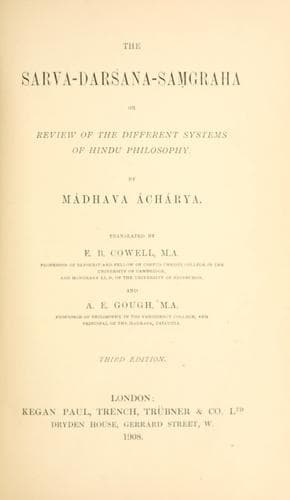
The Sarva-Darsana-Samgraha: Or, Review of the Different Systems of Hindu PhilosophyMadhava
ReligionEastern
The Sarva-Darsana-Samgraha: Or, Review of the Different Systems of Hindu Philosophy
Madhava
Philosophy, Hindu; Philosophy, Indic
This same recognition I set forth. To set forth is to enforce. I
establish this recognition by a stringent process which renders it
convincing. [Such is the articulate development of the first aphorism
of the Recognitive Institutes.]
Here it may be asked: If soul is manifested only as consubstantial
with God, why this laboured effort to exhibit the recognition? The
answer is this:--The recognition is thus exhibited, because though the
soul is, as you contend, continually manifested as self-luminous (and
therefore identical with God), it is nevertheless under the influence
of the cosmothetic illusion manifested as partial, and therefore the
recognition must be exhibited by an expansion of the cognitive and
active powers in order to achieve the manifestation of the soul as
total (the self being to the natural man a part, to the man of insight
the whole, of the divine pleroma). Thus, then, the syllogism: This
self must be God, because it possesses cognitive and active powers;
for so far forth as any one is cognitive and active, to that extent he
is a lord, like a lord in the world of everyday life, or like a king,
therefore the soul is God. The five-membered syllogism is here
employed, because so long as we deal with the illusory order of
things, the teaching of the Naiyáyikas may be accepted. It has thus
been said by the son of Udayákara--
"What self-luminous self can affirm or deny that
self-active and cognitive is Maheśvara the primal being?
"Such recognition must be effected by an expansion of the
powers, the self being cognised under illusion, and
imperfectly discerned."
And again--
"The continuance of all living creatures in this
transmigratory world lasts as long as their respiratory
_involucrum_; knowledge and action are accounted the life of
living creatures.
"Of these, knowledge is spontaneously developed, and action
(or ritual), which is best at Káśi,
"Is indicated by others also: different from these is real
knowledge."
And also--
"The knowledge of these things follows the sequence of those
things:
"The knower, whose essence is beatitude and knowledge
without succession, is Maheśvara."
Sománandanátha also says--
"He always knows by identity with Śiva: he always knows by
identity with the real."
Again at the end of the section on knowledge--
"Unless there were this unity with Śiva, cognitions could
not exist as facts of daily life:
"Unity with God is proved by the unity of light. He is the
one knower (or illuminator of cognitions).
"He is Maheśvara, the great Lord, by reason of the unbroken
continuity of objects:
"Pure knowledge and action are the playful activity of the
deity."
Public-domain text, read in full here on John Shaqi.
Reviews
Reviews
No reviews yet
Be the first to share your thoughts on this work.
Elsewhere in the archive
Join the Discussion
Join the discussion
Sign in to leave a comment or review.
Sign InorCreate an account