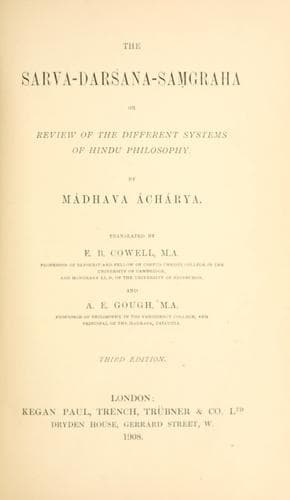
The Sarva-Darsana-Samgraha: Or, Review of the Different Systems of Hindu PhilosophyMadhava
ReligionEastern
The Sarva-Darsana-Samgraha: Or, Review of the Different Systems of Hindu Philosophy
Madhava
Philosophy, Hindu; Philosophy, Indic
The following is an explanation of Abhinava-gupta:--The text, "After
that as it shines shines the all of things, by the light of that
shines diversely this ALL," teaches that God illumines the whole round
of things by the glory of His luminous intelligence, and that the
diversity or plurality of the object world, whereby the light which
irradiates objects is a blue, a yellow light, and the like, arises
from diversity of tint cast upon the light by the object. In reality,
God is without plurality or difference, as transcending all
limitations of space, time, and figure. He is pure intelligence,
self-luminousness, the manifester; and thus we may read in the Śaiva
aphorisms, "Self is intelligence." His synonymous titles are
Intelligential Essence, Unintermitted Cognition, Irrespective
Intuition, Existence as a mass of Beatitude, Supreme Domination. This
self-same existing self is knowledge.
By pure knowledge and action (in the passage of Sománandanátha cited
above) are meant real or transcendent cognition and activity. Of
these, the cognition is self-luminousness, the activity is energy
constructive of the world or series of spheres of transmigratory
experience. This is described in the section on activity--
"He by his power of bliss gives light unto these objects,
through the efficacy of his will: this activity is
creativeness."
And at the close of the same section--
"The mere will of God, when he wills to become the world
under its forms of jar, of cloth, and other objects, is his
activity worked out by motive and agent.
"This process of essence into emanation, whereby if this be
that comes to be, cannot be attributed to motiveless,
insentient things."
According to these principles, causality not pertaining either to the
insentient or to the non-divine intelligence, the mere will of
Maheśvara, the absolute Lord, when he wills to emanate into thousands
of forms, as this or that difference, this or that action, this or
that modification of entity, of birth, continuance, and the like, in
the series of transmigratory environments,--his mere will is his
progressively higher and higher activity, that is to say, his
universal creativeness.
How he creates the world by his will alone is clearly exhibited in the
following illustration--
"The tree or jar produced by the mere will of
thaumaturgists, without clay, without seed, continues to
serve its proper purpose as tree or jar."
If clay and similar materials were really the substantial cause of the
jar and the rest, how could they be produced by the mere volition of
the thaumaturgist? If you say: Some jars and some plants are made of
clay, and spring from seeds, while others arise from the bare volition
of the thaumaturgist; then we should inform you that it is a fact
notorious to all the world that _different_ things must emanate from
different materials.
Public-domain text, read in full here on John Shaqi.
Reviews
Reviews
No reviews yet
Be the first to share your thoughts on this work.
Elsewhere in the archive
Join the Discussion
Join the discussion
Sign in to leave a comment or review.
Sign InorCreate an account