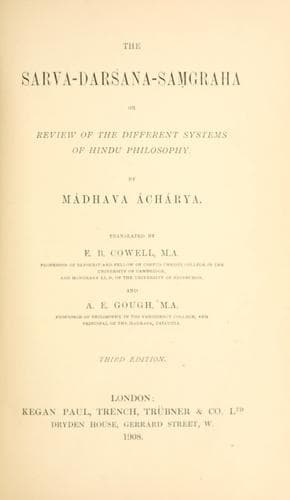
The Sarva-Darsana-Samgraha: Or, Review of the Different Systems of Hindu PhilosophyMadhava
ReligionEastern
The Sarva-Darsana-Samgraha: Or, Review of the Different Systems of Hindu Philosophy
Madhava
Philosophy, Hindu; Philosophy, Indic
As for those who say that a jar or the like cannot be made without
materials to make it of, and that when a thaumaturgist makes one he
does so by putting atoms in motion by his will, and so composing it:
they may be informed that unless there is to be a palpable violation
of the causal relation, _all_ the co-efficients, without exception,
must be desiderated; to make the jar there must be the clay, the
potter's staff, the potter's wheel, and all the rest of it; to make a
body there must be the congress of the male and female, and the
successive results of that congress. Now, if that be the case, the
genesis of a jar, a body, or the like, upon the mere volition of the
thaumaturgist, would be hardly possible.
On the other hand, there is no difficulty in supposing that Mahádeva,
amply free to remain within or to over-step any limit whatever, the
Lord, manifold in his operancy, the intelligent principle, thus
operates. Thus it is that Vasuguptáchárya says--
"To him that painted this world-picture without materials, without
appliances, without a wall to paint it on,--to him be glory, to him
resplendent with the lunar digit, to him that bears the trident."
It may be asked: If the supersensible self be no other than God, how
comes this implication in successive transmigratory conditions? The
answer is given in the section treating of accredited institution--
"This agent of cognition, blinded by illusion, transmigrates
through the fatality of works:
"Taught his divine nature by science, as pure intelligence,
he is enfranchised."
It may be asked: If the subject and the object are identical, what
difference can there be between the self bound and the self liberated
in regard to the objects cognisable by each? The answer to this
question is given in a section of the Tattvártha-Saṅgraha--
"Self liberated cognises all that is cognisable as identical
with itself, like Maheśvara free from bondage: the other (or
unliberated) self has in it infinite plurality."
Public-domain text, read in full here on John Shaqi.
Reviews
Reviews
No reviews yet
Be the first to share your thoughts on this work.
Elsewhere in the archive
Join the Discussion
Join the discussion
Sign in to leave a comment or review.
Sign InorCreate an account