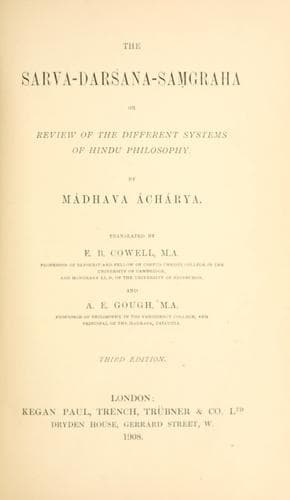
The Sarva-Darsana-Samgraha: Or, Review of the Different Systems of Hindu PhilosophyMadhava
ReligionEastern
The Sarva-Darsana-Samgraha: Or, Review of the Different Systems of Hindu Philosophy
Madhava
Philosophy, Hindu; Philosophy, Indic
An objection may be raised: If the divine nature is essential to the
soul, there can be no occasion to seek for this recognition; for if
all requisites be supplied, the seed does not fail to germinate
because it is unrecognised. Why, then, this toilsome effort for the
recognition of the soul? To such an objection we reply: Only listen to
the secret we shall tell you. All activity about objects is of two
degrees, being either external, as the activity of the seed in
developing the plant, or internal, as the activity which determines
felicity, which consists in an intuition which terminates in the
conscious self. The first degree of activity presupposes no such
recognition as the system proposes, the second does presuppose it. In
the Recognitive System the peculiar activity is the exertion of the
power of unifying personal and impersonal spirit, a power which is the
attainment of the highest and of mediate ends, the activity consisting
in the intuition I am God. To this activity a recognition of the
essential nature of the soul is a pre-requisite.
It may be urged that peculiar activity terminating in the conscious
self is observed independent of recognition. To this it is replied: A
certain damsel, hearing of the many good qualities of a particular
gallant, fell in love with him before she had seen him, and agitated
by her passion and unable to suffer the pain of not seeing him, wrote
to him a love-letter descriptive of her condition. He at once came to
her, but when she saw him she did not recognise in him the qualities
she had heard about; he appeared much the same as any other man, and
she found no gratification in his society. So soon, however, as she
recognised those qualities in him as her companions now pointed them
out, she was fully gratified. In like manner, though the personal self
be manifested as identical with the universal soul, its manifestation
effects no complete satisfaction so long as there is no recognition of
those attributes; but as soon as it is taught by a spiritual director
to recognise in itself the perfections of Maheśvara, his omniscience,
omnipotence, and other attributes, it attains the whole pleroma of
being.
It is therefore said in the fourth section--
"As the gallant standing before the damsel is disdained as
like all other men, so long as he is unrecognised, though he
humble himself before her with all manner of importunities:
In like manner the personal self of mankind, though it be
the universal soul, in which there is no perfection
unrealised, attains not its own glorious nature; and
therefore this recognition thereof must come into play."
This system has been treated in detail by Abhinava-gupta and other
teachers, but as we have in hand a summary exposition of systems, we
cannot extend the discussion of it any further lest our work become
too prolix. This then may suffice.[152]
A. E. G.
FOOTNOTES:
[Footnote 150: Read _bháván_ for _bhávát_.]
Public-domain text, read in full here on John Shaqi.
Reviews
Reviews
No reviews yet
Be the first to share your thoughts on this work.
Elsewhere in the archive
Join the Discussion
Join the discussion
Sign in to leave a comment or review.
Sign InorCreate an account