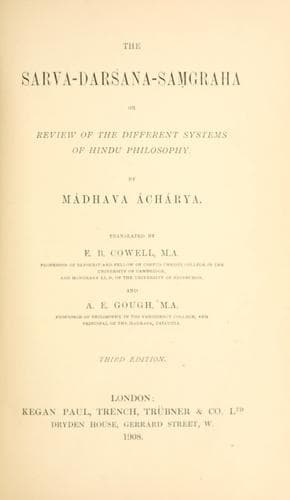
The Sarva-Darsana-Samgraha: Or, Review of the Different Systems of Hindu PhilosophyMadhava
ReligionEastern
The Sarva-Darsana-Samgraha: Or, Review of the Different Systems of Hindu Philosophy
Madhava
Philosophy, Hindu; Philosophy, Indic
[Footnote 151: Cf. _supra_, p. 113. Mádhava here condenses Abhinava
Gupta's commentary. Abhinava Gupta lived in the beginning of the
eleventh century (see Bühler's Tour in Cashmere, pp. 66, 80).]
[Footnote 152: I have seen in Calcutta a short Comm. on the Śiva
sútras by Utpala, the son of Udayákara (cf. pp. 130, 131).--E. B. C.]
CHAPTER IX.
THE RASEŚVARA-DARŚANA OR MERCURIAL SYSTEM.[153]
Other Máheśvaras there are who, while they hold the identity of self
with God, insist upon the tenet that the liberation in this life
taught in all the systems depends upon the stability of the bodily
frame, and therefore celebrate the virtues of mercury or quicksilver
as a means of strengthening the system. Mercury is called _párada_,
because it is a means of conveyance beyond the series of
transmigratory states. Thus it has been said--
"It gives the farther shore of metempsychosis: it is called
_párada_."
And again in the Rasárṇava--
"It is styled _párada_ because it is employed for the
highest end by the best votaries.
"Since this in sleep identical with me, goddess, arises from
my members, and is the exudation of my body, it is called
_rasa_."
It may be urged that the literal interpretation of these words is
incorrect, the liberation in this life being explicable in another
manner. This objection is not allowable, liberation being set out in
the six systems as subsequent to the death of the body, and upon this
there can be no reliance, and consequently no activity to attain to it
free from misgivings. This is also laid down in the same treatise--
"Liberation is declared in the six systems to follow the
death of the body.
"Such liberation is not cognised in perception like an
emblic myrobalan fruit in the hand.
"Therefore a man should preserve that body by means of
mercury and of medicaments."
Govinda-bhagavat also says--
"Holding that the enjoyments of wealth and of the body are
not permanent, one should strive
"After emancipation; but emancipation results from
knowledge, knowledge from study, and study is only possible
in a healthy body."
The body, some one may say, is seen to be perishable, how can its
permanency be effected? Think not so, it is replied, for though the
body, as a complexus of six sheaths or wrappers of the soul, is
dissoluble, yet the body, as created by Hara and Gaurí under the names
of mercury and mica, may be perdurable. Thus it is said in the
Rasahṛidaya--
"They who, without quitting the body, have attained to a new
body, the creation of Hara and Gaurí,
"They are to be lauded, perfected by mercury, at whose
service is the aggregate of magic texts."
Public-domain text, read in full here on John Shaqi.
Reviews
Reviews
No reviews yet
Be the first to share your thoughts on this work.
Elsewhere in the archive
Join the Discussion
Join the discussion
Sign in to leave a comment or review.
Sign InorCreate an account