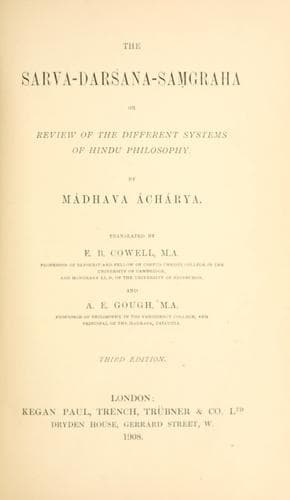
The Sarva-Darsana-Samgraha: Or, Review of the Different Systems of Hindu PhilosophyMadhava
ReligionEastern
The Sarva-Darsana-Samgraha: Or, Review of the Different Systems of Hindu Philosophy
Madhava
Philosophy, Hindu; Philosophy, Indic
The ascetic, therefore, who aspires to liberation in this life should
first make to himself a glorified body. And inasmuch as mercury is
produced by the creative conjunction of Hara and Gaurí, and mica is
produced from Gaurí, mercury and mica are severally identified with
Hara and Gaurí in the verse--
"Mica is thy seed, and mercury is my seed;
"The combination of the two, O goddess, is destructive of
death and poverty."
This is very little to say about the matter. In the
Raseśvara-siddhánta many among the gods, the Daityas, the Munis, and
mankind, are declared to have attained to liberation in this life by
acquiring a divine body through the efficacy of quicksilver.
"Certain of the gods, Maheśa and others; certain Daityas,
Śukra and others;
"Certain Munis, the Bálakhilyas and others; certain kings,
Someśvara and others;
"Govinda-bhagavat, Govinda-náyaka,
"Charvaṭi, Kapila, Vyáli, Kápáli, Kandaláyana,
"These and many others proceed perfected, liberated while
alive,
"Having attained to a mercurial body, and therewith
identified."
The meaning of this, as explicated by Parameśvara to Parameśvarí, is
as follows:--
"By the method of works is attained, O supreme of goddesses,
the preservation of the body;
"And the method of works is said to be twofold, mercury and
air,
"Mercury and air swooning carry off diseases, dead they
restore to life,
"Bound they give the power of flying about."
The swooning state of mercury is thus described--
"They say quicksilver to be swooning when it is perceived,
as characterised thus--
"Of various colours, and free from excessive volatility.
"A man should regard that quicksilver as dead, in which the
following marks are seen--
"Wetness, thickness, brightness, heaviness, mobility."
The bound condition is described in another place as follows:--
"The character of bound quicksilver is that it is--
"Continuous, fluent, luminous, pure, heavy, and that it
parts asunder under friction."
Some one may urge: If the creation of mercury by Hara and Gaurí were
proved, it might be allowed that the body could be made permanent; but
how can that be proved? The objection is not allowable, inasmuch as
that _can_ be proved by the eighteen modes of elaboration. Thus it is
stated by the authorities--
"Eighteen modes of elaboration are to be carefully
discriminated,
"In the first place, as pure in every process, for
perfecting the adepts."
And these modes of elaboration are enumerated thus--
"Sweating, rubbing, swooning, fixing, dropping, coercion,
restraining,
"Kindling, going, falling into globules, pulverising,
covering,
"Internal flux, external flux, burning, colouring, and
pouring,
"And eating it by parting and piercing it,--are the eighteen
modes of treating quicksilver."
Public-domain text, read in full here on John Shaqi.
Reviews
Reviews
No reviews yet
Be the first to share your thoughts on this work.
Elsewhere in the archive
Join the Discussion
Join the discussion
Sign in to leave a comment or review.
Sign InorCreate an account