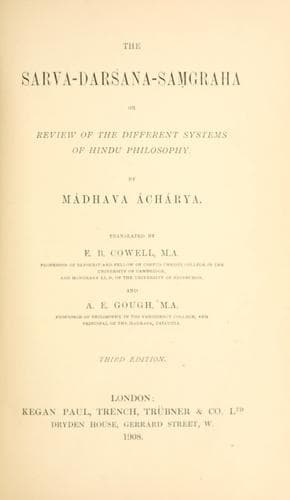
The Sarva-Darsana-Samgraha: Or, Review of the Different Systems of Hindu PhilosophyMadhava
ReligionEastern
The Sarva-Darsana-Samgraha: Or, Review of the Different Systems of Hindu Philosophy
Madhava
Philosophy, Hindu; Philosophy, Indic
These treatments have been described at length by Govinda-bhagavat,
Sarvajña-rámeśvara and the other ancient authorities, and are here
omitted to avoid prolixity.
The mercurial system is not to be looked upon as merely eulogistic of
the metal, it being immediately, through the conservation of the body,
a means to the highest end, liberation. Thus it is said in the
Rasárṇava--
"Declare to me, O god, that supremely efficacious destruction of the
blood, that destruction of the body, imparted by thee, whereby it
attained the power of flying about in the sky. Goddess (he replied),
quicksilver is to be applied both to the blood and to the body. This
makes the appearance of body and blood alike. A man should first try
it upon the blood, and then apply it to the body."
It will be asked: Why should we make this effort to acquire a
celestial body, seeing that liberation is effected by the
self-manifestation of the supreme principle, existence, intelligence,
and beatitude? We reply: This is no objection, such liberation being
inaccessible unless we acquire a healthy body. Thus it is said in the
Rasahṛidaya--
"That intelligence and bliss set forth in all the systems
in which a multitude of uncertainties are melted away,
"Though it manifest itself, what can it effect for beings
whose bodies are unglorified?
"He who is worn out with decrepitude, though he be free from
cough, from asthma, and similar infirmities,
"He is not qualified for meditation in whom the activities
of the cognitive organs are obstructed.
"A youth of sixteen addicted to the last degree to the
enjoyment of sensual pleasures,
"An old man in his dotage, how should either of these attain
to emancipation?"
Some one will object: It is the nature of the personal soul to pass
through a series of embodiments, and to be liberated is to be
extricated from that series of embodiments; how, then, can these two
mutually exclusive conditions pertain to the same bodily tenement? The
objection is invalid, as unable to stand before the following
dilemmatic argument:--Is this extrication, as to the nature of which
all the founders of institutes are at one, to be held as cognisable or
as incognisable? If it is incognisable, it is a pure chimera; if it is
cognisable, we cannot dispense with life, for that which is not alive
cannot be cognisant of it. Thus it is said in the Rasasiddhánta--
"The liberation of the personal soul is declared in the
mercurial system, O subtile thinker.
"In the tenets of other schools which repose on a diversity
of argument,
"Know that this knowledge and knowable is allowed in all
sacred texts;
"One not living cannot know the knowable, and therefore
there is and must be life."
Public-domain text, read in full here on John Shaqi.
Reviews
Reviews
No reviews yet
Be the first to share your thoughts on this work.
Elsewhere in the archive
Join the Discussion
Join the discussion
Sign in to leave a comment or review.
Sign InorCreate an account