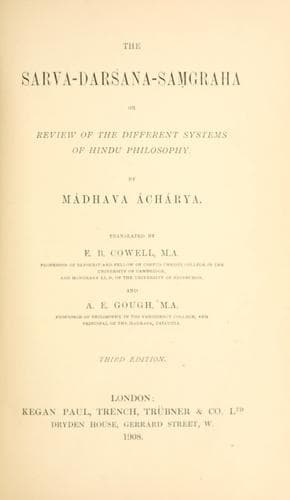
The Sarva-Darsana-Samgraha: Or, Review of the Different Systems of Hindu PhilosophyMadhava
ReligionEastern
The Sarva-Darsana-Samgraha: Or, Review of the Different Systems of Hindu Philosophy
Madhava
Philosophy, Hindu; Philosophy, Indic
"Perfect beatitude, unalloyed, absolute, the essence whereof
is luminousness, undifferenced,
"From which all troubles are fallen away, knowable,
tranquil, self-recognised:
"Fixing the internal organ upon that, seeing the whole
universe manifested, made of pure intelligence,
"The aspirant even in this life attains to the absolute, his
bondage to works annulled."
A Vedic text also declares: That is Rasa (mercury), having obtained
this he becomes beatitude.
Thus, then, it has been shown that mercury alone is the means of
passing beyond the burden of transmigratory pains. And conformably we
have a verse which sets forth the identity between mercury and the
supreme self--
"May that mercury, which is the very self, preserve us from
dejection and from the terrors of metempsychosis,
"Which is naturally to be applied again and again by those
that aspire to liberation from the enveloping illusion,
"Which perfected endures, which plays not again when the
soul awakes,
"Which, when it arises, pains no other soul, which shines
forth by itself from itself."
A. E. G.
FOOTNOTES:
[Footnote 153: Cf. Marco Polo's account of the Indian yogís in Colonel
Yule's edit. vol. ii. p. 300. _Párada-pána_ is one of the practices of
the Siddhopásakas in the Śaṅkara-digvijaya, § 49, to obviate
_apamṛityu_, _akálamṛityu_, &c.]
CHAPTER X.
THE VAIŚESHIKA OR AULÚKYA DARŚANA.[154]
Whoso wishes to escape the reality of pain, which is established by
the consciousness of every soul through its being felt to be
essentially contrary to every rational being, and wishes therefore to
know the means of such escape,--learns that the knowledge of the
Supreme Being is the true means thereof, from the authority of such
passages as these (_Śvetáśvatara Upan_. vi. 20)--
"When men shall roll up the sky as a piece of leather,
"Then shall there be an end of pain without the knowledge of
Śiva."
Now the knowledge of the Supreme is to be gained by hearing
(_śravaṇa_), thought (_manana_), and reflection (_bhávaná_), as it has
been said--
"By scripture, by inference, and by the force of repeated
meditation,--
"By these three methods producing knowledge, he gains the
highest union (_yoga_)."
Here thought depends on inference, and inference depends on the
knowledge of the _vyápti_ (or universal proposition), and the
knowledge of the _vyápti_ follows the right understanding of the
categories,--hence the saint Kaṇáda[155] establishes the six
categories in his tenfold treatise, commencing with the words, "Now,
therefore, we shall explain duty."
Public-domain text, read in full here on John Shaqi.
Reviews
Reviews
No reviews yet
Be the first to share your thoughts on this work.
Elsewhere in the archive
Join the Discussion
Join the discussion
Sign in to leave a comment or review.
Sign InorCreate an account