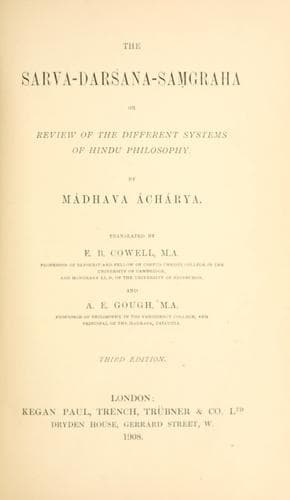
The Sarva-Darsana-Samgraha: Or, Review of the Different Systems of Hindu PhilosophyMadhava
ReligionEastern
The Sarva-Darsana-Samgraha: Or, Review of the Different Systems of Hindu Philosophy
Madhava
Philosophy, Hindu; Philosophy, Indic
In the first book, consisting of two daily lessons, he describes all
the categories which are capable of intimate relation. In the first
_áhnika_ he defines those which possess "genus" (_játi_), in the
second "genus" (or "generality") itself and "particularity." In the
similarly divided second book he discusses "substance," giving in the
first _áhnika_ the characteristics of the five elements, and in the
second he establishes the existence of space and time. In the third
book he defines the soul and the internal sense, the former in the
first _áhnika_, the latter in the second. In the fourth book he
discusses the body and its adjuncts, the latter in the first _áhnika_,
and the former in the second. In the fifth book he investigates
action; in the first _áhnika_ he considers action as connected with
the body, in the second as belonging to the mind. In the sixth book he
examines merit and demerit as revealed in Śruti; in the first _áhnika_
he discusses the merit of giving, receiving gifts, &c., in the second
the duties of the four periods of religious life. In the seventh book
he discusses quality and intimate relation; in the first _áhnika_ he
considers the qualities independent of thought, in the second those
qualities which are related to it, and also intimate relation. In the
eighth book he examines "indeterminate" and "determinate" perception,
and means of proof. In the ninth book he discusses the characteristics
of intellect. In the tenth book he establishes the different kinds of
inference.[156]
The method of this system is said to be threefold, "enunciation,"
"definition," and "investigation."[157] "But," it may be objected,
"ought we not to include 'division,' and so make the method fourfold,
not threefold?" We demur to this, because "division" is really
included in a particular kind of enunciation. Thus when we declare
that substance, quality, action, generality, particularity, and
intimate relation are the only six positive categories,--this is an
example of enunciation. If you ask "What is the reason for this
definite order of the categories?" we answer as follows:--Since
"substance" is the chief, as being the substratum of all the
categories, we enounce this first; next "quality," since it resides in
its generic character in all substances [though different substances
have different qualities]; then "action," as it agrees with
"substance" and "quality" in possessing "generality;"[158] then
"generality," as residing in these three; then "particularity,"
inasmuch as it possesses "intimate relation;"[159] lastly, "intimate
relation" itself; such is the principle of arrangement.
Public-domain text, read in full here on John Shaqi.
Reviews
Reviews
No reviews yet
Be the first to share your thoughts on this work.
Elsewhere in the archive
Join the Discussion
Join the discussion
Sign in to leave a comment or review.
Sign InorCreate an account