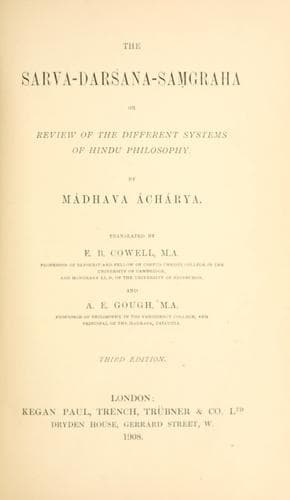
The Sarva-Darsana-Samgraha: Or, Review of the Different Systems of Hindu PhilosophyMadhava
ReligionEastern
The Sarva-Darsana-Samgraha: Or, Review of the Different Systems of Hindu Philosophy
Madhava
Philosophy, Hindu; Philosophy, Indic
If you ask, "Why do you say that there are only six categories since
'non-existence' is also one?" we answer: Because we wish to speak of
the six as positive categories, _i.e._, as being the objects of
conceptions which do not involve a negative idea. "Still," the
objector may retort, "how do you establish this definite number 'only
six'? for either horn of the alternative fails. For, we ask, is the
thing to be thus excluded already thoroughly ascertained or not? If it
is thoroughly ascertained, why do you exclude it? and still more so,
if it is not thoroughly ascertained? What sensible man, pray, spends
his strength in denying that a mouse has horns? Thus your definite
number 'only six' fails as being inapplicable." This, however, we
cannot admit; if darkness, &c., are allowed to form certainly a
seventh category (as "non-existence"), we thus (by our definite
number) deny it to be one of the six _positive_ categories,--and if
others attempt to include "capacity," "number," &c., which we allow
to be certainly positive existences, we thus deny that they make a
_seventh_ category. But enough of this long discussion.
Substantiality, &c. (_dravyatvádi_), _i.e._, the genera of substance,
quality, and action, are the definition of the triad substance,
quality, and action respectively. The genus of substance (_dravyatva_)
is that which, while it alike exists with intimate relation in the
(eternal) sky and the (transitory) lotus, is itself eternal,[160] and
does not exist with intimate relation in smell.[161]
The genus of quality (_guṇatva_) is that which is immediately
subordinate to the genus existence, and exists with intimate relation
in whatever is not an intimate or mediate cause.[162] The genus of
action (_karmatva_) is that which is immediately subordinate to the
genus existence, and is not found with intimate relation in anything
eternal.[163] Generality (or genus, _sámánya_) is that which is found
in many things with intimate relation, and can never be the
counter-entity to emergent non-existence.[164] Particularity[165]
(_viśesha_) exists with intimate relation, but it is destitute of
generality, which stops mutual non-existence.[166] Intimate relation
(_samaváya_) is that connection which itself has not intimate
relation.[167] Such are the definitions of the six categories.
Substance is ninefold,--earth, water, fire, air, ether, time, space,
soul, and mind. The genera of earth, &c. (_pṛithivítva_), are the
definitions of the first four. The genus of earth is that generality
which is immediately subordinate to substance, and resides in the same
subject with colour produced by baking.[168]
Public-domain text, read in full here on John Shaqi.
Reviews
Reviews
No reviews yet
Be the first to share your thoughts on this work.
Elsewhere in the archive
Join the Discussion
Join the discussion
Sign in to leave a comment or review.
Sign InorCreate an account