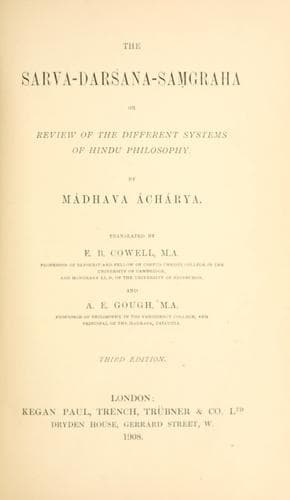
The Sarva-Darsana-Samgraha: Or, Review of the Different Systems of Hindu PhilosophyMadhava
ReligionEastern
The Sarva-Darsana-Samgraha: Or, Review of the Different Systems of Hindu Philosophy
Madhava
Philosophy, Hindu; Philosophy, Indic
the mind which perceives cognitions].[197] Hence we conclude that the
fourth or remaining opinion must be the true one, viz., that darkness
is only the absence of light. And it need not be objected that it is
very difficult to account for the attribution to non-existence of the
qualities of existence, for we all see that the quality happiness _is_
attributed to the absence of pain, and the idea of separation is
connected with the absence of conjunction. And you need not assert
that "this absence of light must be the object of a cognition produced
by the eye in dependence on light, since it is the absence of an
object possessing colour,[198] as we see in the case of a jar's
absence," because by the very rule on which you rely, viz., that that
on which the eye depends to perceive an object, it must also depend on
to perceive that object's absence, it follows that as there is no
dependence of the eye on light to perceive light, it need not depend
thereon to perceive this light's absence. Nor need our opponent retort
that "the cognition of darkness [as the absence of light] necessitates
the cognition of the place where the absence resides [and _this_ will
require light]," as such an assertion is quite untenable, for we
cannot admit that in order to have a conception of absence it is
necessary to have a conception of the place where the absence resides,
else we could not have the perception of the cessation of sound, as is
implied in such an expression as "the tumult has ceased."[199] Hence,
having all these difficulties in his mind, the venerable Kaṇáda
uttered his aphorism [as an _ipse dixit_ to settle the question]:
"_Dravya-guṇa-karma-nish-patti-vaidharmyád abhávas tamas_" (_Vaiś.
Sút._ v. 2, 19), "Darkness is really non-existence, since it is
dissimilar to the production of substances, qualities, or actions."
The same thing has been also established by the argument that darkness
is perceived by the eye[200] [without light, whereas all substances,
if perceptible at all, require the presence of light as well as of the
eye to be visible].
Non-existence (_abháva_) is considered to be the seventh category, as
established by negative proofs. It may be concisely defined as that
which, itself not having intimate relation, is _not_ intimate
relation;[201] and this is twofold, "relative non-existence"[202] and
"reciprocal non-existence."
The former is again divided into "antecedent," "emergent," and
"absolute." "Antecedent" is that non-existence which, though without
any beginning, is not everlasting; "emergent" is that which, though
having a beginning, is everlasting; "absolute" is that non-existence
which abides in its own counter-entity;[203] "reciprocal
non-existence" is that which, being different from "absolute," has yet
no defined limit [_i.e._, no _terminus ad quem_ nor _terminus a quo_,
as "antecedent" and "emergent" have].
Public-domain text, read in full here on John Shaqi.
Reviews
Reviews
No reviews yet
Be the first to share your thoughts on this work.
Elsewhere in the archive
Join the Discussion
Join the discussion
Sign in to leave a comment or review.
Sign InorCreate an account