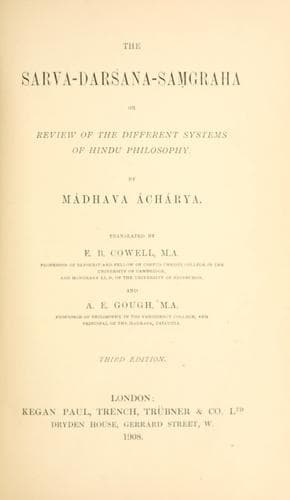
The Sarva-Darsana-Samgraha: Or, Review of the Different Systems of Hindu PhilosophyMadhava
ReligionEastern
The Sarva-Darsana-Samgraha: Or, Review of the Different Systems of Hindu Philosophy
Madhava
Philosophy, Hindu; Philosophy, Indic
If you raise the objection that "'reciprocal non-existence' is really
the same as 'absolute non-existence,'" we reply that this is indeed to
lose one's way in the king's highroad; for "reciprocal non-existence"
is that negation whose opposite is held to be identity, as "a jar is
not cloth;" but "absolute non-existence" is that negation whose
opposite is connection, as "there is no colour in the air."[204] Nor
need you here raise the objection that "_abháva_ can never be a means
of producing any good to man," for we maintain that it is his _summum
bonum_, in the form of final beatitude, which is only another term for
the absolute abolition of all pain [and therefore comes under the
category of _abháva_].
E. B. C.
FOOTNOTES:
[Footnote 154: The Vaiśeshikas are called Aulúkyáḥ in Hemachandra's
_Abhidhána-chintámaṇi_; in the Váyu-puráṇa (quoted in Aufrecht's
_Catal_. p. 53 b, l. 23), Akshapáda, Kaṇáda, Ulúka, and Vatsa are
called the sons of Śiva.]
[Footnote 155: He is here called by his synonym Kaṇabhaksha.]
[Footnote 156: It is singular that this is inaccurate. The ninth book
treats of that perception which arises from supersensible contact,
&c., and inference. The tenth treats of the mutual difference of the
qualities of the soul, and the three causes.]
[Footnote 157: For this extract from the old _bháshya_ of Vátsyáyana,
see Colebrooke's _Essays_ (new edition), vol. i. p. 285.]
[Footnote 158: Cf. _Bháshá-parichchheda_, śloka 14.]
[Footnote 159: "Particularity" (_viśesha_) resides by "intimate
relation" in the eternal atoms, &c.]
[Footnote 160: This clause is added, as otherwise the definition would
apply to "duality" and "conjunction."]
[Footnote 161: This is added, as otherwise the definition would apply
to "existence" (_sattá_), which is the _summum genus_, to which
substance, quality, and action are immediately subordinate.]
[Footnote 162: Existence (_sattá_) is the genus of _dravya_, _guṇa_,
and _kriyâ_. _Dravya_ alone can be the intimate cause of anything; and
all actions are the mediate (or non-intimate) cause of conjunction and
disjunction. _Some_ qualities (as _saṃyoga_, _rúpa_, &c.) may be
mediate causes, but this is accidental and does not belong to the
essence of _guṇa_, as many gunas can never be mediate causes.]
[Footnote 163: As all karmas are transitory, _karmatva_ is only found
in the _anitya_. I correct in p. 105, line 20, _nityá-samavetatva_;
this is the reading of the MS. in the Calcutta Sanskrit College
Library.]
[Footnote 164: _I.e._, it can never be destroyed. Indestructibility,
however, is found in time, space, &c.; to exclude these, therefore,
the former clause of the definition is added.]
Public-domain text, read in full here on John Shaqi.
Reviews
Reviews
No reviews yet
Be the first to share your thoughts on this work.
Elsewhere in the archive
Join the Discussion
Join the discussion
Sign in to leave a comment or review.
Sign InorCreate an account