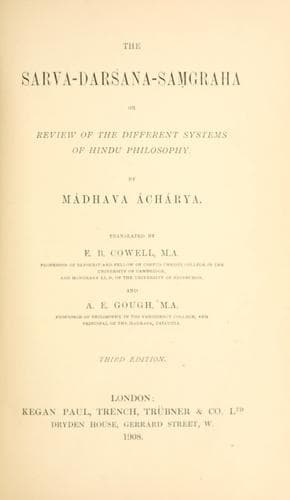
The Sarva-Darsana-Samgraha: Or, Review of the Different Systems of Hindu PhilosophyMadhava
ReligionEastern
The Sarva-Darsana-Samgraha: Or, Review of the Different Systems of Hindu Philosophy
Madhava
Philosophy, Hindu; Philosophy, Indic
[Footnote 165: "Particularity" (whence the name Vaiśeshika) is not
"individuality, as of this particular flash of lightning,"--but it is
the individuality either of those eternal substances which, being
single, have no genus, as ether, time, and space; or of the different
atomic minds; or of the atoms of the four remaining substances, earth,
water, fire, and air, these atoms being supposed to be the _ne plus
ultra_, and as they have no parts, they are what they are by their own
indivisible nature. Ballantyne translated _viśesha_ as "ultimate
difference." I am not sure whether the individual soul has _viśesha_.]
[Footnote 166: Mutual non-existence (_anyonyábháva_) exists between
two notions which have no property in common, as a "pot is not cloth;"
but the genus is the same in two pots, both alike being pots.]
[Footnote 167: "_Samaváyasambandábhávát samaváyo na játiḥ_," Siddh.
Mukt. (_Saṃyoga_ being a _guṇa_ has _guṇatva_ existing in it with
intimate relation).]
[Footnote 168: The feel or touch of earth is said to be "neither hot
nor cold, and its colour, taste, smell, and touch are changed by union
with fire" (Bháshá-parichchheda, _sl._ 103, 104).]
[Footnote 169: The organ of touch is an aërial
integument.--_Colebrooke._]
[Footnote 170: Sound is twofold,--"produced from contact," as the
_first_ sound, and "produced from sound," as the _second_. _Janya_ is
added to exclude God's knowledge, while _saṃyogájanya_ excludes the
soul's, which is produced by contact, as of the soul and mind, mind
and the senses, &c.]
[Footnote 171: The mediate cause itself is the conjunction of time
with some body, &c., existing in time,--this latter is the intimate
cause, while the knowledge of the revolutions of the sun is the
instrumental cause. In p. 106, line 12, read _adhikaraṇaṃ_.]
[Footnote 172: _Paratva_ being of two kinds, _daiśika_ and _kálika_.]
[Footnote 173: Time, space, and mind have no special qualities; the
last, however, is not pervading but atomic.]
[Footnote 174: The three other _padárthas_, beside soul, which are
_amúrtta_,--time, ether, and space,--are not genera.]
[Footnote 175: All numbers, from duality upwards, are artificial,
_i.e._, they are made by our minds; unity alone exists in things
themselves--each being _one_; and they only become two, &c., by our
choosing to regard them so, and thus joining them in thought.]
[Footnote 176: _Saṃskára_ is here the idea conceived by the
mind--created, in fact, by its own energies out of the material
previously supplied to it by the senses and the internal organ or
mind. (Cf. the tables in p. 153.)]
[Footnote 177: Here and elsewhere I omit the metrical summary of the
original, as it adds nothing new to the previous prose.]
[Footnote 178: Every cause must be either _jñápaka_ or _janaka_;
_apekshábuddhi_, not being the former, must be the latter.]
Public-domain text, read in full here on John Shaqi.
Reviews
Reviews
No reviews yet
Be the first to share your thoughts on this work.
Elsewhere in the archive
Join the Discussion
Join the discussion
Sign in to leave a comment or review.
Sign InorCreate an account