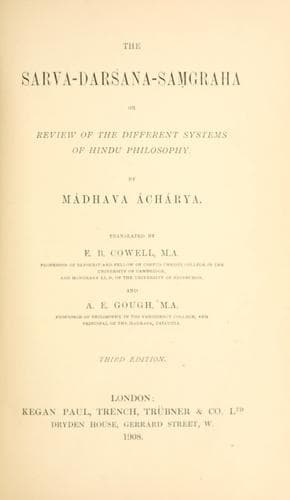
The Sarva-Darsana-Samgraha: Or, Review of the Different Systems of Hindu PhilosophyMadhava
ReligionEastern
The Sarva-Darsana-Samgraha: Or, Review of the Different Systems of Hindu Philosophy
Madhava
Philosophy, Hindu; Philosophy, Indic
[Footnote 179: _Apekshábuddhi_ apprehends "this is one," "this is
one," &c.; but duality, for instance, does not reside in either of
these, but in _both_ together.]
[Footnote 180: The Vaiśeshikas held that the jívátman and space are
each an all-pervading substance, but the individual portions of each
have different special qualities; hence one man knows what another is
ignorant of, and one portion of ether has sound when another portion
has not. Dr. Röer, in his version of the Bháshá-Parichchheda, has
mistranslated an important Sútra which bears on this point. It is said
in Sútra 26--
_----athákáśaśaríriṇam, avyápyavṛittiḥ kshaṇiko viśesha-guṇa
ishyate,_
which does not mean "the special qualities of ether and soul are
limitation to space and momentary duration," but "the special
qualities of ether and soul (_i.e._, sound, knowledge, &c.) are
limited to different portions and of momentary duration."]
[Footnote 181: The author here mentions two other causes of the
destruction of _dvitva_ besides that already given in p. 152, l. 14
(_apekshábuddhi-náśa_), viz., _áśrayanáśa_, and the united action of
_both_:--
1. Ekatva-jñána |Avayava-kriyá | . . .
2. Apekshábuddhi |Avayava-vibhága |Avayava-kriyá.
3. Dvitvotpatti and |Avayava-saṃyoga-náśa |Avayava-vibhága.
ekatva-jñána-náśa | |
4. Dvitvatvajñána |Dvitvádhárasya |Avayava-saṃyoga-náśa.
|(_i.e._, |
|avayavinaḥ) náśaḥ |
5. Dvitvaguṇa-buddhi|Dvitva-náśa |Ádhára-náśa
and |of avayavin). (_i.e._, |
apekshábuddhi-náśa |(of avayavin). |
6. Dvitva-náśa and | . . . |Dvitva-náśa.
dravya-buddhi | |
The second and third columns represent what takes place when, in the
course of the six steps of _ekatvajñána_, &c., one of the two parts is
itself divided either at the _first_ or the _second_ moment. In the
first case, the _dvitva_ of the whole is destroyed in the fifth
moment, and therefore its only cause is its immediately preceding
_dvitvádhára-náśa_, or, as Mádhava calls it, _áśrayanivṛitti_. In the
second case, the _náśa_ arrives at the same moment simultaneously by
both columns (1) and (3), and hence it may be ascribed to the united
action of two causes, _apekshábuddhi-náśa_ and _ádhára-náśa_. Any
_kriyá_ which arose in one of the parts after the second moment would
be unimportant, as the _náśa_ of the _dvitva_ of the whole would take
place by the original sequence in column (1) in the sixth moment; and
in this way it would be too late to affect that result.]
Public-domain text, read in full here on John Shaqi.
Reviews
Reviews
No reviews yet
Be the first to share your thoughts on this work.
Elsewhere in the archive
Join the Discussion
Join the discussion
Sign in to leave a comment or review.
Sign InorCreate an account