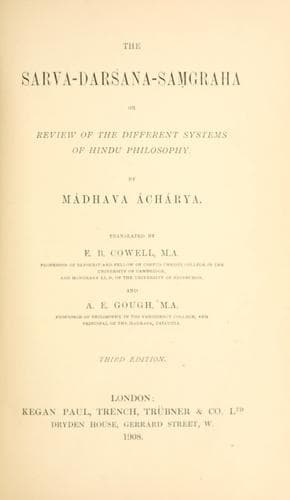
The Sarva-Darsana-Samgraha: Or, Review of the Different Systems of Hindu PhilosophyMadhava
ReligionEastern
The Sarva-Darsana-Samgraha: Or, Review of the Different Systems of Hindu Philosophy
Madhava
Philosophy, Hindu; Philosophy, Indic
[Footnote 182: _I.e._, from the destruction of _apekshábuddhi_ follows
the destruction of _dvitva_; but the other destructions previously
described were followed by some production,--thus the knowledge of
_dvitvatva_ arose from the destruction of _ekatvajñána_, &c. (cf.
Siddh. Mukt., p. 107). I may remind the reader that in Hindu logic the
counter-entity to the non-existence of a thing is the thing itself.]
[Footnote 183: From the conjunction of fire is produced an action in
the atoms of the jar; thence a separation of one atom from another;
thence a destruction of the conjunction of atoms which made the black
(or unbaked) jar; thence the destruction of the compound of two
atoms.]
[Footnote 184: _I.e._, a kind of initiative tendency.]
[Footnote 185: These are explained at full length in the Siddhánta
Muktávalí, pp. 104, 105. In the first series we have--1. the
destruction of the _dvyaṇuka_ and simultaneously a disjunction from
the old place produced by the disjunction (of the parts); 2. the
destruction of the black colour in the _dvyaṇuka_, and the
simultaneous destruction of the conjunction of the _dvyaṇuka_ with
that place; 3. the production of the red colour in the atoms, and the
simultaneous conjunction with another place; 4. the cessation of the
action in the atom produced by the original conjunction of fire. The
remaining 5-10 agree with the 4-9 above.]
[Footnote 186: The Vaiśeshikas hold that when a jar is baked, the old
black jar is _destroyed_, its several compounds of two atoms, &c.,
being destroyed; the action of the fire then produces the red colour
in the separate atoms, and, joining these into new compounds,
eventually produces a new red jar. The exceeding rapidity of the steps
prevents the eye's detecting the change of the jars. The followers of
the Nyáya maintain that the fire penetrates into the different
compounds of two or more atoms, and, without any destruction of the
old jar, produces its effects on these compounds, and thereby changes
not the jar but its colour, &c.,--it is still the same jar, only it is
red, not black.]
[Footnote 187: In p. 109, line 14, I read
_gagaṇavibhágakartṛitvasya_.]
[Footnote 188: The Siddhánta Muktávalí, p. 112, describes the series
of steps:--1. An action, as of breaking, in one of the halves; 2. the
disjunction of the two halves; 3. the destruction of the conjunction
which originally produced the pot; 4. the destruction of the pot; 5.
by the disjunction of the two halves is produced a disjunction of the
severed half from the old place; 6. the destruction of the conjunction
with that old place; 7. the conjunction with the new place; 8. the
cessation of the original impulse of fracture. Here the second
disjunction (viz., of the half of the pot and the place) is produced
by the previous disjunction of the halves, the intimate causes of the
pot.]
[Footnote 189: The original has a plural _vibhágán_, _i.e._,
disjunctions from the several points.]
Public-domain text, read in full here on John Shaqi.
Reviews
Reviews
No reviews yet
Be the first to share your thoughts on this work.
Elsewhere in the archive
Join the Discussion
Join the discussion
Sign in to leave a comment or review.
Sign InorCreate an account