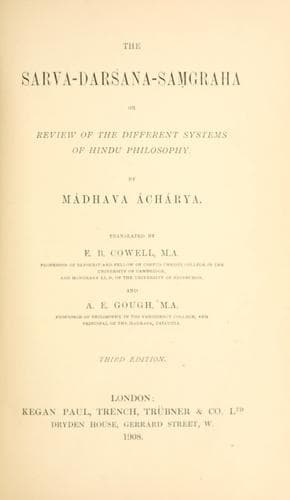
The Sarva-Darsana-Samgraha: Or, Review of the Different Systems of Hindu PhilosophyMadhava
ReligionEastern
The Sarva-Darsana-Samgraha: Or, Review of the Different Systems of Hindu Philosophy
Madhava
Philosophy, Hindu; Philosophy, Indic
[Footnote 190: _I.e._, the disjunction of the hand and the points of
space.]
[Footnote 191: The author of a commentary on the Bhagavad Gítá.]
[Footnote 192: For _dravyádi_ read _pṛithivyádi_.]
[Footnote 193: I am not sure that it would not be better to read
_viddhavevidhayá_, rewounding the wounded, instead of _vṛiddhavívadhayá_.]
[Footnote 194: Unless you _see_ the rope you cannot mistake it for a
serpent.]
[Footnote 195: In p. 110, last line, read _'bháve_.]
[Footnote 196: Read in p. 110, last line, _anavadhánádishu_.
_Vidhipratyaya_ properly means an imperative or potential affix implying
"command;" but the pandit takes _vidhi_ here as _bhávabodhaka-kriyá_. It
has that meaning in Kávya-prakáśa, V. (p. 114, l. 1).]
[Footnote 197: The mind perceives _áloka-jñána_, therefore it would
perceive its absence, _i.e._, darkness, but this last is perceived by
the _eye_.]
[Footnote 198: _I.e._, light possesses colour, and we cannot see a
jar's absence in the dark.]
[Footnote 199: Sound resides in the imperceptible ether, and cessation
is the _dhvaṃsábháva_, or "emergent non-existence."]
[Footnote 200: The reading _pratyayavedyatvena_ seems supported by p.
110, last line, but it is difficult to trace the argument; I have,
therefore, ventured hesitatingly to read _pratyakshavedyatvena_, and
would refer to the commentary (Vaiś. Sút. p. 250), "_yadi hi
níla-rúpavan nílaṃ rúpam eva vá tamaḥ syát, váhyálokapragraham
antareṇa chakshushá na gṛihyeta_."]
[Footnote 201: Intimate relation has also no intimate relation.]
[Footnote 202: "Relative non-existence" (_saṃsargábháva_) is the
negation of a relation; thus "the jar is not in the house" is
"absolute non-existence," "it was not in the house" is "antecedent,"
and "it will not be in the house" is "emergent," non-existence.]
[Footnote 203: _I.e._, the absolute absence of the jar is found in the
jar, as, of course, the jar does not reside in the jar, but in the
spot of ground,--it is the _játi ghaṭatva_ which resides in the jar.]
[Footnote 204: The opposite is "there _is_ colour in the air."]
CHAPTER XI.
THE AKSHAPÁDA (OR NYÁYA) DARŚANA.
Public-domain text, read in full here on John Shaqi.
Reviews
Reviews
No reviews yet
Be the first to share your thoughts on this work.
Elsewhere in the archive
Join the Discussion
Join the discussion
Sign in to leave a comment or review.
Sign InorCreate an account