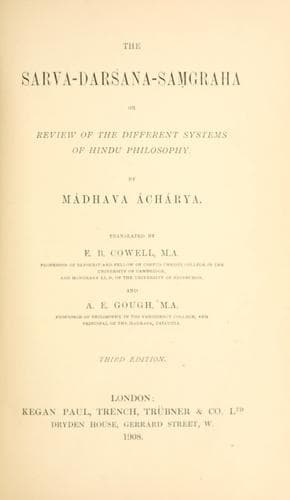
The Sarva-Darsana-Samgraha: Or, Review of the Different Systems of Hindu PhilosophyMadhava
ReligionEastern
The Sarva-Darsana-Samgraha: Or, Review of the Different Systems of Hindu Philosophy
Madhava
Philosophy, Hindu; Philosophy, Indic
The principle that final bliss, _i.e._, the absolute abolition of
pain, arises from the knowledge of the truth [though in a certain
sense universally accepted], is established in a special sense as a
particular tenet[205] of the Nyáya school, as is declared by the
author of the aphorisms in the words "proof, that which is to be
proved, &c.,--from knowledge of the truth as to these things there is
the attainment of final bliss." This is the first aphorism of the
Nyáya Śástra. Now the Nyáya Śástra consists of five books, and each
book contains two "daily portions." In the first daily portion of the
first book the venerable Gotama discusses the definitions of nine
categories, beginning with "proof," and in the second those of the
remaining seven, beginning with "discussion" (_váda_). In the first
daily portion of the second book he examines "doubt," discusses the
four kinds of "proof," and refutes the suggested objections to their
being instruments of right knowledge; and in the second he shows that
"presumption," &c., are really included in the four kinds of "proof"
already given [and therefore need not be added by the Mímáṃsakas as
separate ones]. In the first daily portion of the third book he
examines the soul, the body, the senses, and their objects; in the
second, "understanding" (_buddhi_), and "mind" (_manas_). In the first
daily portion of the fourth book he examines "volition" (_pravṛitti_),
the "faults," "transmigration," "fruit" [of actions], "pain," and
"final liberation;" in the second he investigates the truth[206] as to
the causes of the "faults," and also "wholes" and "parts." In the
first daily portion of the fifth book he discusses the various kinds
of futility (_játi_), and in the second the various kinds of "occasion
for rebuke" (_nigrahasthána_, or "unfitness to be argued with").
In accordance with the principle that "to know the thing to be
measured you must first know the measure," "proof" (_pramáṇa_) is
first enunciated, and as this must be done by defining it, we have
first a definition of "proof." "Proof" is that which is always
accompanied by right knowledge, and is at the same time not disjoined
from the proper instruments [as the eye, &c.], and from the site of
knowledge [_i.e._, the soul];[207] and this definition thus includes
the peculiar tenet of the Nyáya School that God is a source of right
knowledge,[208] as the author of the aphorisms has expressly declared
(ii. 68), "and the fact of the Veda's being a cause of right
knowledge, like spells and the medical science, follows from the fact
that the fit one who gave the Veda was a source of right knowledge."
And thus too hath the universally renowned teacher Udayana, who saw to
the farthest shore of the ocean of logic, declared in the fourth
chapter of the Kusumáñjali:
"Right knowledge is accurate comprehension, and right knowing is the
possession thereof; authoritativeness is, according to Gotama's
school, the being separated from all absence thereof.
Public-domain text, read in full here on John Shaqi.
Reviews
Reviews
No reviews yet
Be the first to share your thoughts on this work.
Elsewhere in the archive
Join the Discussion
Join the discussion
Sign in to leave a comment or review.
Sign InorCreate an account