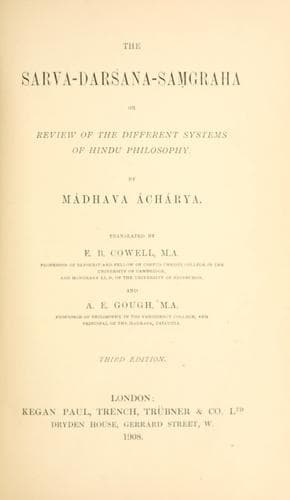
The Sarva-Darsana-Samgraha: Or, Review of the Different Systems of Hindu PhilosophyMadhava
ReligionEastern
The Sarva-Darsana-Samgraha: Or, Review of the Different Systems of Hindu Philosophy
Madhava
Philosophy, Hindu; Philosophy, Indic
"He in whose intuitive unerring perception, inseparably united to Him
and dependent on no foreign inlets, the succession of all the various
existing objects is contained,--all the chaff of our suspicion being
swept away by the removal of all possible faults as caused by the
slightest want of observation in Him,--He, Śiva, is my authority; what
have I to do with others, darkened as their authority must ever be
with rising doubts?"
"Proof" is fourfold, as being divided into perception, inference,
analogy, and testimony. The "thing to be proved" [or the "object of
right notion"] is of twelve kinds, viz., soul, body, the senses, their
objects, understanding, mind, volition, faults, transmigrations,
fruit, pain, and final liberation. "Doubt" is a knowledge whose nature
is uncertainty; and this is threefold, as being caused by the object's
possessing only qualities which are common to other things also, and
therefore not distinctive,--or by its possessing only irrelevant
qualities of its own, which do not help us in determining the
particular point in question,[209]--or by conflicting testimony. The
thing which one proposes to one's self before proceeding to act, is "a
motive" (_prayojana_); this is twofold, _i.e._, visible and invisible.
"An example" is a fact brought forward as a ground for establishing a
general principle, and it may be either affirmative or negative.[210]
A "tenet" (_siddhánta_) is something which is accepted as being
authoritatively settled as true; it is of four kinds, as being "common
to all the schools," "peculiar to one school," "a pregnant assumption"
[leading, if conceded, to a further conclusion], and "an implied
dogma" (i. 26-31). The "member" (of a demonstration) is a part of the
sentence containing an inference for the sake of another; and these
are five, the proposition, the reason, the example, the application,
and the conclusion (i. 32-38). "Confutation" (_tarka_, i. 39) is the
showing that the admission of a false minor necessitates the admission
of a false major[211] (cf. Sút. i. 39, and iv. 3); and this is of
eleven kinds, as _vyágháta_, _átmáśraya_, _itaretaráśraya_, &c.
Public-domain text, read in full here on John Shaqi.
Reviews
Reviews
No reviews yet
Be the first to share your thoughts on this work.
Elsewhere in the archive
Join the Discussion
Join the discussion
Sign in to leave a comment or review.
Sign InorCreate an account