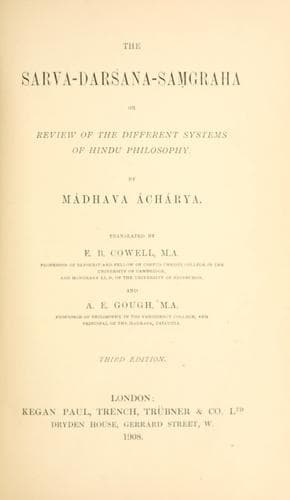
The Sarva-Darsana-Samgraha: Or, Review of the Different Systems of Hindu PhilosophyMadhava
ReligionEastern
The Sarva-Darsana-Samgraha: Or, Review of the Different Systems of Hindu Philosophy
Madhava
Philosophy, Hindu; Philosophy, Indic
"Ascertainment" (_nirṇaya_, i. 40) is right knowledge or a perception
of the real state of the case. It is of four kinds as produced by
perception, inference, analogy, or testimony. "Discussion" (_váda_) is
a particular kind of conversation, having as its end the ascertainment
of truth (i. 41). "Wrangling" (_jalpa_) is the talk of a man only
wishing for victory, who is ready to employ arguments for either side
of the question (i. 42). "Cavilling" (_vitaṇdá_) is the talk of a man
who does not attempt to establish his own side of the question (i.
43). "Dialogue" (_kathá_) is the taking of two opposite sides by two
disputants. A "fallacy" is an inconclusive reason which is supposed to
prove something, and this may be of five kinds, the "erratic," the
"contradictory," the "uncertain," the "unproved," and the "precluded"
or "mistimed" (Sút. i. 44-49). "Unfairness" (_chhala_) is the bringing
forward a contrary argument by using a term wilfully in an ambiguous
sense; this is of three kinds, as there may be fraud in respect of a
term, the meaning, or a metaphorical phrase (i. 50-54). "Futility"
(_játi_) is a self-destructive argument (i. 58). This is of
twenty-four kinds (as described in the fifth book of the Nyáya
aphorisms) (1-38). "Occasion for rebuke" is where the disputant loses
his cause [by stupidity], and this is of twenty-two kinds (as
described in the fifth book of the aphorisms, 44-67). We do not insert
here all the minute subdivisions through fear of being too
prolix,--they are fully explained in the aphorisms.
But here an objector may say, "If these sixteen topics, proof, &c.,
are all thus fully discussed, how is it that it has received the name
of the Nyáya Śástra, [as reasoning, _i.e._, _Nyáya_, or logic,
properly forms only a small part of the topics which it treats of?]"
We allow the force of the objection; still as names are proverbially
said to be given for some special reason, we maintain that the name
Nyáya was rightly applied to Gotama's system, since "reasoning," or
inference for the sake of another, is justly held to be a predominant
feature from its usefulness in all kinds of knowledge, and from its
being a necessary means for every kind of pursuit. So it has been said
by Sarvajña, "This is the pre-eminent science of Nyáya from its
establishing our doctrines against opponents, and from its producing
action;"[212] and by Pakshila Swámin, "This is the science of
reasoning (_ánvíkshikí_) divided into the different categories,
'proof,' &c.; the lamp of all sciences, the means for aiding all
actions, the ultimate appeal of all religious duties, well proved in
the declarations of science."[213]
Public-domain text, read in full here on John Shaqi.
Reviews
Reviews
No reviews yet
Be the first to share your thoughts on this work.
Elsewhere in the archive
Join the Discussion
Join the discussion
Sign in to leave a comment or review.
Sign InorCreate an account