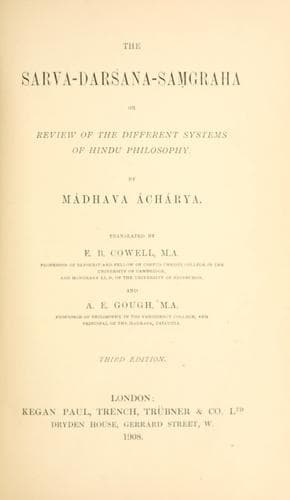
The Sarva-Darsana-Samgraha: Or, Review of the Different Systems of Hindu PhilosophyMadhava
ReligionEastern
The Sarva-Darsana-Samgraha: Or, Review of the Different Systems of Hindu Philosophy
Madhava
Philosophy, Hindu; Philosophy, Indic
But here an objector may say, "When you declare that final liberation
arises from the knowledge of the truth, do you mean that liberation
ensues immediately upon this knowledge being attained?" We reply,
"No," for it is said in the second Nyáya aphorism, "Pain, birth,
activity, faults, false notions,--on the successive annihilation of
these in turn, there is the annihilation of the one next before it,"
by means of this knowledge of the truth. Now false notions are the
thinking the body, &c., which are not the soul, to be the soul;
"faults" are a desire for those things which seem agreeable to the
soul, and a dislike to those things which seem disagreeable to
it,[214] though in reality nothing is either agreeable or disagreeable
to the soul. And through the mutual reaction of these different
"faults" the stupid man desires and the desiring man is stupid; the
stupid man is angry, and the angry man is stupid. Moreover the man,
impelled by these faults, does those things which are forbidden: thus
by the body he does injury, theft, &c.; by the voice, falsehood, &c.;
by the mind, malevolence, &c.; and this same sinful "activity"
produces demerit. Or, again, he may do laudable actions by his body,
as alms, saving others, &c., truthful speaking, upright counsel, &c.,
by his voice, and guilelessness, &c., by his mind; and this same right
activity produces merit. But both are forms of activity, and each
leads to a similar laudable or blamable birth or bodily manifestation;
and while this birth lasts there arises the impression of "pain,"
which we are conscious of as of something that jars against us. Now
this series, beginning with "false notions" and ending with "pain," is
continually going on, and is what we mean by the words "mundane
existence," which rolls on ceaselessly, like a waterwheel. And
whenever some pre-eminent man, by the force of his previous good
deeds, obtains through the teaching of a great teacher the knowledge
that all this present life is only a scene of pain and bound up with
pain, he recognises that it is all to be avoided, and desires to
abolish the ignorance, &c., which are the causes that produced
it.[215] Then he learns that the one means to abolish it is the
knowledge of the truth; and as he meditates on the objects of right
knowledge divided into the four sciences,[216] there arises in his
mind the knowledge of the truth, or, in other words, a right view of
things as they are; and from this knowledge of the truth false notions
disappear. When false notions disappear, the "faults" pass away; with
them ceases "activity;" and with it ceases "birth;" and with the
cessation of "birth" comes the entire abolition of "pain," and this
absolute abolition is final bliss. Its absoluteness consists in this,
that nothing similar to that which is thus abolished can ever revive,
as is expressly said in the second aphorism of the Nyáya Sútras:
"Pain, birth, activity, faults, false notions,--since, on the
Public-domain text, read in full here on John Shaqi.
Reviews
Reviews
No reviews yet
Be the first to share your thoughts on this work.
Elsewhere in the archive
Join the Discussion
Join the discussion
Sign in to leave a comment or review.
Sign InorCreate an account