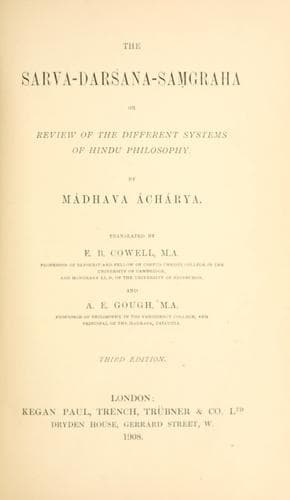
The Sarva-Darsana-Samgraha: Or, Review of the Different Systems of Hindu PhilosophyMadhava
ReligionEastern
The Sarva-Darsana-Samgraha: Or, Review of the Different Systems of Hindu Philosophy
Madhava
Philosophy, Hindu; Philosophy, Indic
successive annihilation of these in turn, there is the annihilation of
the one next before it, there is [on the annihilation of the last of
them] final beatitude."
"But is not your definition of the _summum bonum_, liberation, _i.e._,
'the absolute abolition of pain,' after all as much beyond our reach
as treacle on the elbow is to the tongue;[217] why then is this
continually put forth as if it were established beyond all dispute?"
We reply that as all those who maintain liberation in any form do
include therein the absolute abolition of pain, our definition, as
being thus a tenet accepted in all the schools, may well be called the
royal highway[218] of philosophy. No one, in fact, maintains that pain
is possible without the individual's activity. Thus even the
Mádhyamika's opinion that "liberation consists in the abolition of
soul," does not controvert our point, so far at any rate as that it is
the abolition of pain. But if you proceed to argue that the soul, as
being the cause of pain, is to be abolished just like the body, &c.,
we reply that this does not hold, since it fails under either
alternative. For do you mean by "the soul," (_a._) the continued
succession of cognitions, or (_b._) something different therefrom?
(_a._) If the former, we make no objection, [since we Naiyáyikas allow
that cognition is evanescent,[219] and we do desire to abolish
cognition as a cause of _pravṛitti_ or action[220]], for who would
oppose a view which makes for his own side? (_b._) But if the latter,
then, since it must be eternal,[221] its abolition is impossible; and,
again, a second objection would be that no one would try to gain your
supposed "_summum bonum_;" for surely no sensible person would strive
to annihilate the soul, which is always the dearest of all, on the
principle that "everything else is dear for the soul's pleasure;"
and, again, everybody uses such a phrase as "liberated," [and this
very term refutes the idea of annihilation or abolition].
"But why not say with those Bauddhas who hold the doctrine of pure
intelligence [_i.e._, the Yogácháras and the Sautrántikas[222]], that
'the _summum bonum_' is the rising of pure intelligence consequent on
the cessation of the conscious subject?" To this view we object that
there is an absence of means; and also it cannot be established that
the locus [or subject] of the two states is the same. For the former,
if it is replied that the well-known fourfold set of Bauddha
contemplations[223] are to be accepted as the cause, we answer that,
as [according to the Bauddha tenet of the momentary existence of all
things] there cannot be one abiding subject of these contemplations,
they will necessarily exercise a languid power like studies pursued at
irregular intervals, and be thus ineffectual to produce any distinct
recognition of the real nature of things.
Public-domain text, read in full here on John Shaqi.
Reviews
Reviews
No reviews yet
Be the first to share your thoughts on this work.
Elsewhere in the archive
Join the Discussion
Join the discussion
Sign in to leave a comment or review.
Sign InorCreate an account