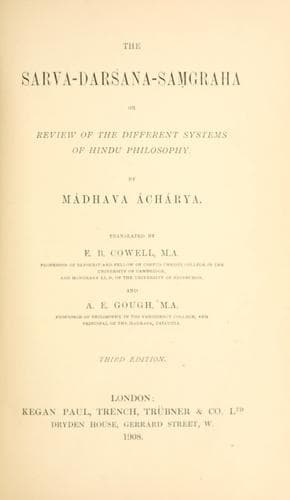
The Sarva-Darsana-Samgraha: Or, Review of the Different Systems of Hindu PhilosophyMadhava
ReligionEastern
The Sarva-Darsana-Samgraha: Or, Review of the Different Systems of Hindu Philosophy
Madhava
Philosophy, Hindu; Philosophy, Indic
"Well, let all this be granted; but the activity of God in creating
the world, what end did it have in view? His own advantage or some
other being's? If it was for the former end, was it in order to attain
something desired, or to avoid something not desired? It could not be
the first, because this would be quite incongruous in a being who
possesses every possible desire gratified; and for the same reason too
it could not be the second. If it was for the latter end [the
advantage of another] it would be equally incongruous; for who would
call that being "wise" who busied himself in acting for another? If
you replied that His activity was justified by compassion, any one
would at once retort that this feeling of compassion should have
rather induced Him to create all living beings happy, and not
checkered with misery, since this militates against His compassion;
for we define compassion as the disinterested wish to avoid causing
another pain. Hence we conclude that it is not befitting for God to
create the world." This has been said by Bhaṭṭáchárya--
"Not even a fool acts without some object in view;
"Suppose that God did not create the world, what end would
be left undone by Him?"--
We reply, O thou crest-jewel of the atheistic school, be pleased for
a moment to close thy envy-dimmed eyes, and to consider the following
suggestions. His action in creation is indeed solely caused by
compassion; but the idea of a creation which shall consist only of
happiness is inconsistent with the nature of things, since there
cannot but arise eventual differences from the different results which
will ripen from the good or evil actions of the beings who are to be
created. Nor need you object that this would interfere with God's own
independence [as He would thus seem to depend on others' actions],
since there is the well-known saying, "One's own body does not hinder
one;" nay rather it helps to carry out one's aims;[243] and for this
there is authority in such passages of the Veda as that (in the
Śvetáśvatara Upanishad, iii. 2), "There is one Rudra only; he
admits[244] not of a second," &c. "But then how will you remedy your
deadly sickness of reasoning in a circle? [for you have to prove the
Veda by the authority of God, and then again you have to prove God's
existence by the Veda"]. We reply, that we defy you to point out any
reasoning in a circle in our argument. Do you suspect this "reciprocal
dependence of each," which you call "reasoning in a circle," in regard
to their being produced or in regard to their being known?[245] It
cannot be the former, for though the production of the Veda is
dependent on God, still as God Himself is eternal, there is no
possibility of _His_ being produced; nor can it be in regard to their
being known, for even if our knowledge of God were dependent on the
Veda, the Veda might be learned from some other source; nor, again,
can it be in regard to the knowledge of the non-eternity of the Veda,
Public-domain text, read in full here on John Shaqi.
Reviews
Reviews
No reviews yet
Be the first to share your thoughts on this work.
Elsewhere in the archive
Join the Discussion
Join the discussion
Sign in to leave a comment or review.
Sign InorCreate an account