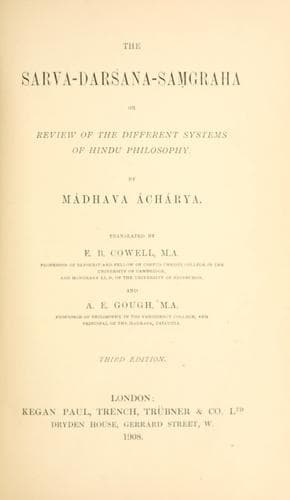
The Sarva-Darsana-Samgraha: Or, Review of the Different Systems of Hindu PhilosophyMadhava
ReligionEastern
The Sarva-Darsana-Samgraha: Or, Review of the Different Systems of Hindu Philosophy
Madhava
Philosophy, Hindu; Philosophy, Indic
for the non-eternity of the Veda is easily perceived by any _yogin_
endowed with the transcendent faculties (_tívra_,[246] &c.)
Therefore, when God has been rendered propitious by the performance of
duties which produce His favour, the desired end, Liberation, is
obtained; thus everything is clear.
E. B. C.
* * * * *
NOTE ON PAGES 172, 173.
We have here an exemplification of the five fallacies or _hetvábhásas_
of the modern Hindu logic (cf. _Siddhántamukt._, § 71, _Tarkasaṃgr._,
55-67), viz., _anaikánta_, _viruddha_, _asiddha_, _kálátyayopadishṭa_
or _bádhita_, and _pratipakshita_ or _sat-pratipaksha_. The four first
of these generally correspond to the _savyabhichára_ or "erratic,"
_viruddha_ or "contradictory," _sádhyasama_ or "unproved," and
_atítakála_ or "mistimed," _i.e._, "precluded," as given in the list
of fallacies of the older logic in p. 164; but _pratipakshita_
corresponds imperfectly to _prakaraṇasama_. The _prakaraṇasama_ or
"uncertain" reason is properly that reason which is equally available
for both sides, as, _e.g._, the argument, "Sound is eternal because it
is audible," which could be met by the equally plausible argument,
"Sound is non-eternal because it is audible;" or, according to other
authorities, it is that reason which itself raises the same
difficulties as the original question, as, _e.g._, "sound is
non-eternal because eternal qualities are not perceived in it;" here
this alleged reason is as much the subject of dispute as the old
question, "Is sound eternal?" But the _pratipakshita_ reason is one
which is counter-balanced by an equally valid reason, as "Sound is
eternal because it is audible," and "Sound is non-eternal because it
is a product."
FOOTNOTES:
[Footnote 205: Cf. Nyáya Sútras, i. 29.]
[Footnote 206: In p. 112, line 16, of the Calcutta edition, I read
_doshanimitta-tattva_ for _doshanimittakatva_ (compare Nyáya Sút. iv.
68).]
[Footnote 207: Without this last clause the definition might include
the objects (_vishaya_), as these are, of course, connected with right
knowledge.]
[Footnote 208: Íśvara is a cause of right knowledge (_pramáṇa_)
according to the definition, because he is _pramáyá áśrayaḥ_.]
[Footnote 209: On this compare Siddhánta-Muktávali, p. 115.]
[Footnote 210: On these compare my note to Colebrooke's Essays, vol.
i. p. 315.]
[Footnote 211: "Our coming to the conclusion that there can be no
smoke in the hill if there be no fire, while we _see_ the smoke, is
the confutation of there being no fire in the hill" (_Ballantyne_).
Or, in other words, "the mountain must have the absence-of-smoke
(_vyápaka_) if it has the absence-of-fire (the false _vyápya_").]
[Footnote 212: Action (_pravṛitti_) follows after the ascertainment of
the truth by _nyáya_.]
[Footnote 213: Cp. Vátsyáyana's Comment., p. 6. The Calcutta edition
reads _prakírtitá_ for _paríkshitá_.]
Public-domain text, read in full here on John Shaqi.
Reviews
Reviews
No reviews yet
Be the first to share your thoughts on this work.
Elsewhere in the archive
Join the Discussion
Join the discussion
Sign in to leave a comment or review.
Sign InorCreate an account