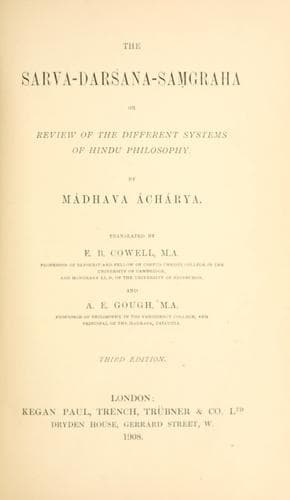
The Sarva-Darsana-Samgraha: Or, Review of the Different Systems of Hindu PhilosophyMadhava
ReligionEastern
The Sarva-Darsana-Samgraha: Or, Review of the Different Systems of Hindu Philosophy
Madhava
Philosophy, Hindu; Philosophy, Indic
[Footnote 214: The printed text omits the third fault, "a stupid
indifference, _moha_," which is however referred to presently.]
[Footnote 215: In p. 116, line 3, I would read _tannirvartakam_ for
_tannivartakam_.]
[Footnote 216: This refers to the couplet so often quoted in Hindu
authors, "Logic, the three Vedas, trade and agriculture, and the
eternal doctrine of polity,--these four sciences are the causes of the
stability of the world" (cf. Manu, vii. 43). It occurs in Kámandaki's
_Nítisára_, ii. 2, and seems to be referred to in Vátsyáyana's Com. p.
3, from which Mádhava is here borrowing.]
[Footnote 217: Compare the English proverb, "As soon as the cat can
lick her ear."]
[Footnote 218: Literally the "bell-road," _i.e._, "the chief road
through a village, or that by which elephants, &c., decorated with
tinkling ornaments, proceed."--_Wilson's Dict._]
[Footnote 219: The cognition is produced in the first moment, remains
during the second, and ceases in the third.]
[Footnote 220: See Nyáya Sút. i. 2.]
[Footnote 221: As otherwise why should we require liberation at all?
Or rather the author probably assumes that other Naiyáyikas have
sufficiently established this point against its opponents, cf. p. 167,
line 11.]
[Footnote 222: See _supra_, pp. 24-32.]
[Footnote 223: All is momentary, all is pain, all is _sui generis_,
all is unreal.]
[Footnote 224: In the form of the various _kleśas_ or "afflictions."]
[Footnote 225: _Ávaraṇa_, cf. pp. 55, 58.]
[Footnote 226: But the Nyáya holds that the attributes of the soul, as
happiness, desire, aversion, &c., are perceived by the internal sense,
mind (Bháshá P. § 83).]
[Footnote 227: The reading _múrtapratibandhát_ is difficult, but I
believe that _pratibandha_ means here _vyápti_, as it does in Sánkhya
Sútras, i. 100.]
[Footnote 228: The true _summum bonum_ must be
_niratiśaya_,--incapable of being added to.]
[Footnote 229: _Yogyánupalabdhi_ is when an object is not seen, and
yet all the usual concurrent causes of vision are present, as the eye,
light, &c.]
[Footnote 230: Alluding to the Vedic phrase, "_grávánaḥ plavanti_,"
see Uttara Naishadha, xvii. 37. The phrase _aśmánaḥ plavanti_ occurs
in Shaḍv. Br. 5, 12.]
[Footnote 231: Or perhaps "capable of being surpassed."]
[Footnote 232: Since the Supreme Being is a single instance.]
[Footnote 233: Since the Veda, if non-eternal, must [to be
authoritative] have been created by God, and yet it is brought forward
to reveal the existence of God.]
[Footnote 234: The Nyáya holds presumption to be included under
inference, and comparison is declared to be the ascertaining the
relation of a name to the thing named.]
[Footnote 235: Since ether is connected by contact with the parts of
everything, as _e.g._, a jar.]
Public-domain text, read in full here on John Shaqi.
Reviews
Reviews
No reviews yet
Be the first to share your thoughts on this work.
Elsewhere in the archive
Join the Discussion
Join the discussion
Sign in to leave a comment or review.
Sign InorCreate an account