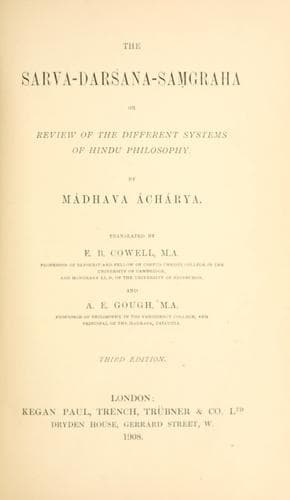
The Sarva-Darsana-Samgraha: Or, Review of the Different Systems of Hindu PhilosophyMadhava
ReligionEastern
The Sarva-Darsana-Samgraha: Or, Review of the Different Systems of Hindu Philosophy
Madhava
Philosophy, Hindu; Philosophy, Indic
[Footnote 236: The whole (as the jar) resides by intimate relation in
its parts (as the jar's two halves). But the eternal substances,
ether, time, the soul, mind, and the atoms of earth, water, fire, and
air, do not thus reside in anything, although, of course, the category
_viśesha_ does reside in them by intimate relation. The word
"substances" excludes _tantutva_, and "existing in intimate relation"
excludes ether, &c.]
[Footnote 237: Intermediate between infinite and infinitesimal, all
eternal substances being the one or the other.]
[Footnote 238: The _viruddha-hetu_ is that which is never found where
the major term is.]
[Footnote 239: This and much more of the whole discussion is taken
from the Kusumáñjali, v. 2, and I extract my note on the passage
there. "The older Naiyáyikas maintained that the argument 'the
mountain has fire because it has blue smoke,' involved the fallacy of
vyápyatvásiddhi, because the alleged middle term was unnecessarily
restricted (see Siddhánta Muktáv. p. 77). The moderns, however, more
wisely consider it as a harmless error, and they would rather meet the
objection by asserting that there is no proof to establish the
validity of the assumed middle term."]
[Footnote 240: For the _upádhi_ cf. pp. 7, 8.]
[Footnote 241: As in the former case it would be clear that it is a
subject for separate discussion; and in the latter you would be liable
to the fault of _áśrayásiddhi_, a "baseless inference," since your
subject (or minor term), being itself non-existent, cannot be the
locus or subject of a negation (cf. Kusumáñjali, iii. 2). "Just as
that subject from which a given attribute is excluded cannot be
unreal, so neither can an unreal thing be the subject of a negation."]
[Footnote 242: If God is known, then His existence must be granted; if
He is not known, how can we argue about Him? I read lines 15, 16, in
p. 120 of the Calcutta edition, _vikalpaparáhatatvát_, and then begin
the next clause with _syád etat_. The printed text, _vikalpaparáhataḥ
syát tad etat_, seems unintelligible.]
[Footnote 243: The aggregate of the various subtile bodies constitutes
Hiraṇyagarbha, or the supreme soul viewed in His relation to the world
as creator, while the aggregate of the gross bodies similarly
constitutes his gross body (viráj).]
[Footnote 244: The usual reading is _tasthur_ for _tasthe_.]
[Footnote 245: For these divisions of the _anyonyáśraya_ fallacy, see
_Nyáyasútra vṛitti_, i. 39 (p. 33).]
[Footnote 246: For _tívra_ cf. _Yoga sútras_, i. 21, 22.]
CHAPTER XII.
THE JAIMINI-DARŚANA.
Public-domain text, read in full here on John Shaqi.
Reviews
Reviews
No reviews yet
Be the first to share your thoughts on this work.
Elsewhere in the archive
Join the Discussion
Join the discussion
Sign in to leave a comment or review.
Sign InorCreate an account