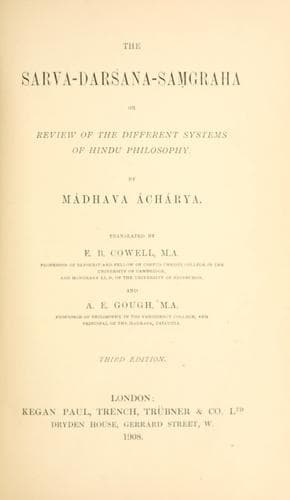
The Sarva-Darsana-Samgraha: Or, Review of the Different Systems of Hindu PhilosophyMadhava
ReligionEastern
The Sarva-Darsana-Samgraha: Or, Review of the Different Systems of Hindu Philosophy
Madhava
Philosophy, Hindu; Philosophy, Indic
An objector may here ask, "Are you not continually repeating that
merit (_dharma_) comes from the practice of duty (_dharma_), but how
is duty to be defined or proved?" Listen attentively to my answer. A
reply to this question has been given in the older[247] Mímáṃsá by the
holy sage Jaimini. Now the Mímáṃsá consists of twelve books.[248] In
the first book is discussed the authoritativeness of those collections
of words which are severally meant by the terms injunction (_vidhi_),
"explanatory passage" (_arthaváda_), hymn (_mantra_), tradition
(_smṛiti_), and "name." In the second, certain subsidiary discussions
[as _e.g._, on _apúrva_] relating to the difference of various rites,
refutation of (erroneously alleged) proofs, and difference of
performance [as in "constant" and "voluntary" offerings]. In the
third, _Śruti_, "sign" or "sense of the passage" (_liṅga_), "context"
(_vákya_), &c., and their respective weight when in apparent
opposition to one another, the ceremonies called _pratipatti-karmáṇi_,
things mentioned incidentally (_anárabhyádhíta_), things accessory to
several main objects, as _prayájas_, &c., and the duties of the
sacrificer. In the fourth, the influence on other rites of the
principal and subordinate rites, the fruit caused by the _juhú_ being
made of the _butea frondosa_, &c., and the dice-playing, &c., which
form subordinate parts of the _rájasúya_ sacrifice. In the fifth, the
relative order of different passages of _Śruti_, &c., the order of
different parts of a sacrifice [as the seventeen animals at the
_vájapeya_], the multiplication and non-multiplication of rites, and
the respective force of the words of _Śruti_, order of mention, &c.,
in determining the order of performance. In the sixth, the persons
qualified to offer sacrifices, their obligations, the substitutes for
enjoined materials, supplies for lost or injured offerings, expiatory
rites, the _sattra_ offerings, things proper to be given, and the
different sacrificial fires. In the seventh, transference of the
ceremonies of one sacrifice to another by direct command in the Vaidic
text, and then as inferred by "name" or "sign." In the eighth,
transference by virtue of the clearly expressed or obscurely expressed
"sign," or by the predominant "sign," and cases where no transference
takes place. In the ninth, the beginning of the discussion on the
adaptation of hymns when quoted in a new connection (_úha_), the
adaptation of _sámans_ and _mantras_, and collateral questions
connected therewith. In the tenth, the discussion of occasions where
the non-performance of the primary rite involves the "preclusion" and
non-performance of the dependent rites, and of occasions where rites
are precluded because other rites produce their special result,
discussions connected with the _graha_ offerings, certain _sámans_,
and various other things, and a discussion on the different kinds of
negation. In the eleventh, the incidental mention and subsequently the
Public-domain text, read in full here on John Shaqi.
Reviews
Reviews
No reviews yet
Be the first to share your thoughts on this work.
Elsewhere in the archive
Join the Discussion
Join the discussion
Sign in to leave a comment or review.
Sign InorCreate an account