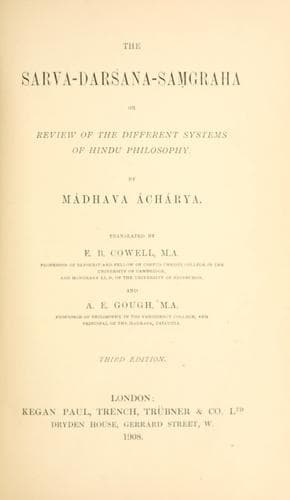
The Sarva-Darsana-Samgraha: Or, Review of the Different Systems of Hindu PhilosophyMadhava
ReligionEastern
The Sarva-Darsana-Samgraha: Or, Review of the Different Systems of Hindu Philosophy
Madhava
Philosophy, Hindu; Philosophy, Indic
fuller discussion of _tantra_[249] [where several acts are combined
into one], and _ávápa_ [or the performing an act more than once]. In
the twelfth, a discussion on _prasaṅga_ [where the rite is performed
for one chief purpose, but with an incidental further reference],
_tantra_, cumulation of concurrent rites (_samuchchaya_) and option.
Now the first topic which introduces the discussions of the
Púrva-Mímáṃsá arises from the aphorism, "Now therefore a desire to
know duty [is to be entertained by thee"]. Now the learned describe a
"topic" as consisting of five members, and these are (_a._) the
subject, (_b._) the doubt, (_c._) the _primâ facie_ argument, (_d._)
the demonstrated conclusion, and (_e._) the connection (_saṅgati_).
The topic is discussed according to the doctrines held by the great
teachers of the system. Thus the "subject" to be discussed is the
sentence, "The Veda is to be read." Now the "doubt" which arises is
whether the study of Jaimini's _śástra_ concerning duty, beginning
with the aphorism, "Duty is a thing which is to be recognised by an
instigatory passage," and ending with "and from seeing it in the
_anváhárya_," is to be commenced or not. The _primâ facie_ argument is
that it is not to be commenced, whether the injunction to read the
Veda be held to have a visible and present or an invisible and future
fruit. (_a._) If you say that this injunction must have a visible
fruit, and this can be no other[250] than the knowledge of the meaning
of what is read, we must next ask you whether this said reading is
enjoined as something which otherwise would not have been thought of,
or whether as something which otherwise would have been optional, as
we see in the rule for shelling rice.[251] It cannot be the former,
for the reading of the Veda is a means of knowing the sense thereof
from its very nature as reading, just as in the parallel instance of
reading the Mahábhárata; and we see by this argument that it would
present itself as an obvious means quite independently of the
injunction. Well, then, let it be the latter alternative; just as the
baked flour cake called _puroḍása_ is made only of rice prepared by
being unhusked in a mortar, when, but for the injunction, it might
have been unhusked by the finger-nails. There, however, the new moon
and full moon sacrifices only produce their unseen effect, which is
the principal _apúrva_, by means of the various minor effects or
subordinate _apúrvas_, produced by the various subordinate parts of
the whole ceremony; and consequently the minor _apúrva_ of the
unhusking is the reason there for the restricting injunction. But in
the case which we are discussing, there is no such reason for any such
restriction, as the rites can be equally well performed by gaining the
knowledge of the Veda's meaning by reading a written book, or by
studying under an authorised teacher. Hence we conclude that there is
no injunction to study the Púrva Mímáṃsá as a means of knowing the
sense of the Veda.
Public-domain text, read in full here on John Shaqi.
Reviews
Reviews
No reviews yet
Be the first to share your thoughts on this work.
Elsewhere in the archive
Join the Discussion
Join the discussion
Sign in to leave a comment or review.
Sign InorCreate an account