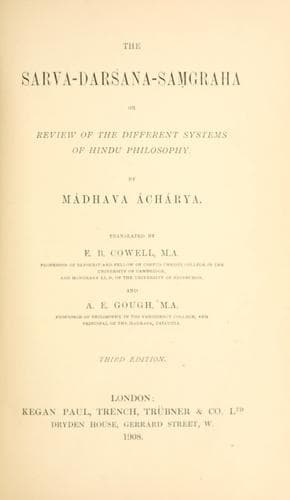
The Sarva-Darsana-Samgraha: Or, Review of the Different Systems of Hindu PhilosophyMadhava
ReligionEastern
The Sarva-Darsana-Samgraha: Or, Review of the Different Systems of Hindu Philosophy
Madhava
Philosophy, Hindu; Philosophy, Indic
(_b._) "What, then, becomes of the Vedic
injunction, 'The Veda is to be read'?" Well, you must be content with
the fact that the injunction will have heaven as its [future] fruit,
although it merely enjoins the making oneself master of the literal
words of the Vedic text [without any care to understand the meaning
which they may convey], since heaven, though not expressly mentioned,
is to be assumed as the fruit, according to the analogy of the
Viśvajit offering. Just as Jaimini, in his aphorism (iv. 3, 15), "Let
that fruit be heaven, since it equally applies to all," establishes
that those who are not expressly mentioned are still qualified to
offer the Viśvajit sacrifice, and infers by argument that its
characteristic fruit is heaven, so let us assume it to be in the
present case also. As it has been said--
"Since the visible fruit would be equally obtained without the
injunction, this cannot be its sole object; we must rather suppose
heaven to be the fruit from the injunction's significance, after the
analogy of the Viśvajit, &c."
Thus, too, we shall keep the Smṛiti rule from being violated: "Having
read the Veda, let him bathe." For this rule clearly implies that no
long interval is to take place between reading the Veda and the
student's return to his home; while, according to your opinion, after
he had read the Veda, he would still have to remain in his preceptor's
house to read the Mímáṃsá discussions, and thus the idea of no
interval between would be contradicted. Therefore for these three
reasons, (_a._) that the study of Mímáṃsá is not enjoined, (_b._) that
heaven can be obtained by the simple reading of the text, and (_c._)
that the rule for the student's return to his home is thus fulfilled,
we maintain that the study of the Mímáṃsá discussions on duty is not
to be commenced.
The "authoritative conclusion" (_siddhánta_), however, is as
follows:--
Public-domain text, read in full here on John Shaqi.
Reviews
Reviews
No reviews yet
Be the first to share your thoughts on this work.
Elsewhere in the archive
Join the Discussion
Join the discussion
Sign in to leave a comment or review.
Sign InorCreate an account