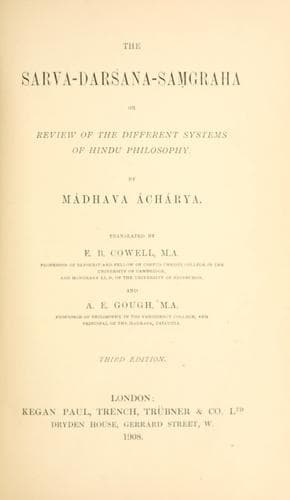
The Sarva-Darsana-Samgraha: Or, Review of the Different Systems of Hindu PhilosophyMadhava
ReligionEastern
The Sarva-Darsana-Samgraha: Or, Review of the Different Systems of Hindu Philosophy
Madhava
Philosophy, Hindu; Philosophy, Indic
We grant that it cannot be a case of _vidhi_, for it might have been
adopted on other grounds; but not even Indra with his thunderbolt
could make us lose our hold of the other alternative that it is a case
of _niyama_. In the sentence, "The Veda is to be read," the affix
_tavya_ expresses an enforcing power in the word,[252] which is to be
rendered visible by a corresponding action in man, bringing a certain
effect into existence; and this enforcing power seeks some
corresponding end which is connected with the man's creative effort.
Now it cannot be the act itself of reading, as suggested by the whole
word _adhyetavya_, which it thus seeks as an end; for this act of
reading, thus expressed by the word, could never be regarded as an
end, since it is a laborious operation of the voice and mind,
consisting in the articulate utterance of the portion read. Nor could
the portion read, as suggested by the whole sentence, be regarded as
the end. For the mass of words called "Veda," which is what we really
mean by the words "portion read," being eternal and omnipresent, could
never fulfil the conditions of the four "fruits of action,"
production, &c.[253] Therefore the only true end which remains to us
is the knowledge of the meaning, as obtained by carrying out the
sense of the words of the injunction. According to the old rule, "He
has the right who has the want, the power, and the wit," those who are
aiming to understand certain things, as the new and full moon
sacrifices, use their daily reading to learn the truth about them. And
the injunction for reading, since it virtually excludes the reading of
written books, &c. [from the well-known technical sense of the word
"read" when used in this connection], conveys the idea that the
reading the Veda enjoined has a consecrated character [as taught by a
duly authorised teacher]. Therefore, as the principal _apúrva_,
produced by the great new and full moon sacrifices, necessitates and
establishes the subordinate _apúrvas_ produced by the inferior
sacrificial acts, as unhusking the rice, &c., so the mass of _apúrva_
produced by all the sacrifices necessitates and establishes a previous
_apúrva_ produced by the restricting injunction (_niyama_), which
prescribes reading the Veda as the means to know how to perform these
sacrifices. If you hesitate to concede that a _niyama_ could have this
future influence called _apúrva_, the same doubt might equally
invalidate the efficacy of a _vidhi_ [as the two stand on the same
level as to their enjoining power]. Nor is the supposition a valid one
that heaven is the fruit, according to the analogy of the _Viśvajit_
offering, since, if there is a present and visible fruit in the form
of a knowledge of the meaning of the sacred text, it is improper to
suppose any other future and unseen fruit. Thus it has been said--
Public-domain text, read in full here on John Shaqi.
Reviews
Reviews
No reviews yet
Be the first to share your thoughts on this work.
Elsewhere in the archive
Join the Discussion
Join the discussion
Sign in to leave a comment or review.
Sign InorCreate an account