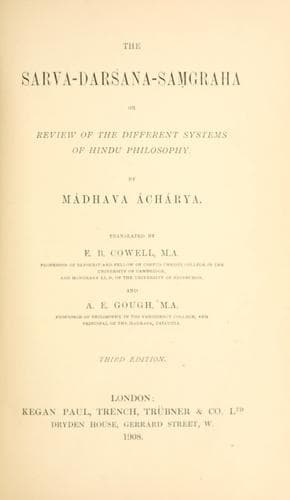
The Sarva-Darsana-Samgraha: Or, Review of the Different Systems of Hindu PhilosophyMadhava
ReligionEastern
The Sarva-Darsana-Samgraha: Or, Review of the Different Systems of Hindu Philosophy
Madhava
Philosophy, Hindu; Philosophy, Indic
"Where a seen fruit is obtained, you must not suppose an
unseen one; but if a _vidhi_ has the restricting meaning of
a _niyama_, it does not thereby become meaningless."
But an objector may say, "Although a man who reads the simple text of
the Veda may not attain to a knowledge of its meaning, still, as he
who reads the Veda with its _aṅgas_, grammar, &c., may attain to this
knowledge, the study of Mímáṃsá will be useless." But this is not
true: for even though he may attain to a simple knowledge of the
literal meaning, all deeper investigation must depend on this kind of
discussion. For instance, when it is said, "He offers anointed
gravel," neither grammar nor _nigama_[254] nor _nirukta_ will
determine the true meaning that it is to be anointed with ghee and not
with oil, &c.; it is only by a Mímáṃsá discussion that the true
meaning is unravelled from the rest of the passage, "Verily, ghee is
brightness."[255] It is therefore established that the study of
Mímáṃsá is enjoined. Nor need it be supposed that this contradicts the
passage of Smṛiti, "Having read the Veda, let him bathe," which
implies that he should now leave his teacher's house, and prohibits
any further delay; as the words do not necessarily imply that the
return to the paternal roof is to follow immediately on his having
read the Veda, but only that it is to follow it at some time, and that
both actions are to be done by the same person, just as we see in the
common phrase, "Having bathed, he eats." Therefore from the purport of
the injunction we conclude that the study of the Púrva Mímáṃsá Śástra,
consisting of a thousand "topics,"[256] is to be commenced. This topic
is connected with the main subject of the Śástra as being a subsidiary
digression, as it is said, "They call that a subsidiary digression
which helps to establish the main subject."[257]
I now proceed to give a sketch of the discussion of the same "topic"
in accordance with the teaching of the Guru Prabhákara.
Public-domain text, read in full here on John Shaqi.
Reviews
Reviews
No reviews yet
Be the first to share your thoughts on this work.
Elsewhere in the archive
Join the Discussion
Join the discussion
Sign in to leave a comment or review.
Sign InorCreate an account