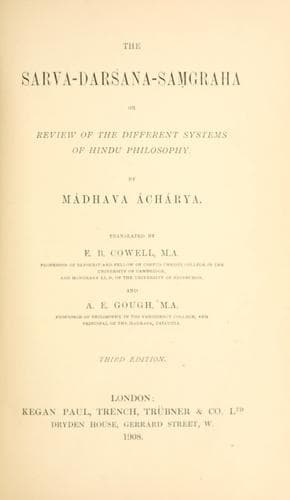
The Sarva-Darsana-Samgraha: Or, Review of the Different Systems of Hindu PhilosophyMadhava
ReligionEastern
The Sarva-Darsana-Samgraha: Or, Review of the Different Systems of Hindu Philosophy
Madhava
Philosophy, Hindu; Philosophy, Indic
In the Smṛiti rule,[258] "Let him admit as a pupil the Brahman lad when
eight years old (by investing him with the sacred cord), let him instruct
him," the object of the direction appears to be the pupil's instruction.
Now a direction must have reference to somebody to be directed; and if you
ask who is here to be directed, I reply, "He who desires to be a teacher,"
since, by Páṇini's rule (i. 3, 36), the root _ní_ is used in the
_átmanepada_ when honour, &c., are implied, _i.e._, here the duty which a
teacher performs to his pupils. He who is to be directed as to admitting a
pupil is the same person who is to be directed as to teaching him, since
both are the object of one and the same command. Hence the inspired sage
Manu has said (ii. 140), "The Bráhman who girds his pupil with the
sacrificial cord and then instructs him in the Veda, with its subsidiary
_aṅgas_ and mystic doctrines, they call a spiritual teacher (_áchárya_)."
Now the teaching which is the function of the teacher cannot be fulfilled
without the learning which is the function of the pupil, and therefore the
very injunction to teach implies and establishes a corresponding
obligation to learn, since the influencer's efforts fail without those of
one to be influenced. If you object that this view does not make reading
the Veda the object of definite injunction, I reply, What matters it to us
if it is not? For even if there is no reason for us to admit a separate
injunction for reading the Veda, it will still remain perpetually enjoined
as a duty, because the passage which mentions it is a perpetual _anuváda_
or "supplementary repetition."[259] Therefore the former _primâ facie_
argument and its answer, which were given before under the idea that there
was a definite injunction to read the Veda, must now be discussed in
another way to suit this new view.
Now the _primâ facie_ argument was that the study of Mímáṃsá, not
being authoritatively enjoined, is not to be commenced; the
"conclusion" was that it is to be commenced as being thus
authoritatively enjoined.
Public-domain text, read in full here on John Shaqi.
Reviews
Reviews
No reviews yet
Be the first to share your thoughts on this work.
Elsewhere in the archive
Join the Discussion
Join the discussion
Sign in to leave a comment or review.
Sign InorCreate an account