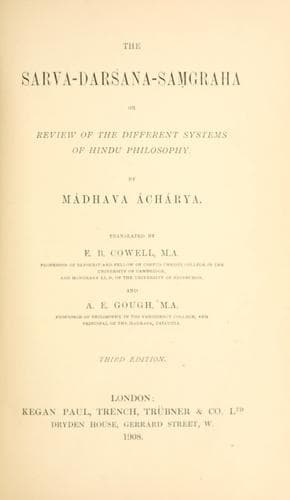
The Sarva-Darsana-Samgraha: Or, Review of the Different Systems of Hindu PhilosophyMadhava
ReligionEastern
The Sarva-Darsana-Samgraha: Or, Review of the Different Systems of Hindu Philosophy
Madhava
Philosophy, Hindu; Philosophy, Indic
Now the upholders of the former or _primâ facie_ view argue as
follows:--"We put to the advocates of the conclusion the following
dilemma: Does the injunction to teach imply that the pupil is to
understand the meaning of what is read, or does it only refer to the
bare reading? It cannot be the former, for obviously the act of
teaching cannot depend for its fulfilment on the pupil's understanding
what is taught [as this will depend on his ability as a recipient];
and the latter will not help you, as, if the bare reading is
sufficient, the Mímáṃsá discussions in question will have no subject
or use. For their proper subject is a point in the Veda, which is
doubted about from having been only looked at in a rough and impromptu
way; now if there is no need of understanding the meaning at all, why
should we talk of doubts and still more of any hope of ascertaining
the true meaning by means of laborious discussion? And therefore in
accordance with the well-known principle, 'That which is a thing of
use and not a matter of doubt is an object of attainment to an
intelligent man, as, for instance, a jar which is in broad light and
in contact with the external and internal senses,' as there is in the
present case no such thing as a subject to exercise it upon, or a
useful end to be attained by it, we maintain that the study of Mímáṃsá
is not to be commenced."
We grant, in reply, that the injunction to teach does not imply a
corresponding necessity that the student must understand the meaning;
still when a man has read the Veda with its subsidiary _aṅgas_, and
has comprehended the general connection of the words with their
respective meanings, this will imply an understanding of the meaning
of the Veda, just as it would in any ordinary human compositions. "But
may we not say that, just as in the case of the mother who said to her
son, 'Eat poison,' the meaning literally expressed by the words was
not what she wished to convey, since she really intended to forbid his
eating anything at all in such and such a house; so if the literal
meaning of the Veda does not express its real purport, the old
objection will recur with full force that the study of Mímáṃsá will
have neither subject nor end [as there will be no use in understanding
the literal meaning, since, as in the mother's case, it may only lead
astray, and so common sense must be the ultimate judge"]. We reply,
that your supposed illustration and the case in question are not
really parallel. In the supposed illustration the primary meaning of
the words would be obviously precluded, because a direction to eat
poison would be inconceivable in the mouth of an authoritative and
trustworthy speaker like a mother, and you would know at once that
this could not be what she wished to say; but in the case of the Veda,
which is underived from any personal author, why should not the
literal meaning be the one actually intended? And it is just the
Public-domain text, read in full here on John Shaqi.
Reviews
Reviews
No reviews yet
Be the first to share your thoughts on this work.
Elsewhere in the archive
Join the Discussion
Join the discussion
Sign in to leave a comment or review.
Sign InorCreate an account